A design file can look finished and still not be ready to manufacture.
Over the past six months, we've seen a steady rise in RFQs that arrive with an AI-generated design attached — sometimes a concept image from a text-to-image tool, sometimes a CAD model built with AI assistance. These files tend to share one trait: they look complete. Smooth surfaces, detailed geometry, the kind of finish that suggests real design effort went into them. Our engineers usually need only a few seconds with the file before something gets flagged — a wall section that's unrealistically thin, a transition surface no cutting tool could actually reach, or a tolerance that's simply a software default with no real connection to what the part needs to do.
That's part of what brought this topic to mind. The 48th WorldSkills Competition wrapped up in Shanghai this September, and one of the running themes at the accompanying conference was AI's effect on the skilled trades — with a session built specifically around how people and AI should divide the work, not whether AI will replace people. That framing lines up with a question we run into on the shop floor almost every week: if you're holding an AI-generated design, can it actually go straight to production?
A file that looks complete and a part that can actually be manufactured are two different things. And the gap between them can cost more than it looks like it should.
What AI-Generated Models Usually Leave Out
A production-ready engineering file is more than geometry. What really determines whether a part can be manufactured consistently is how tolerances are defined, what condition the material is in, and which process can realistically produce each feature — and that's exactly the information an AI-generated concept model usually doesn't include. There's typically no GD&T, so the file has no formal tolerance or form definition to check the part against. There's often no real material assignment either — a model can "look like aluminum" without the file containing any density or yield-strength data. And there's no revision history, so the file sits outside a normal engineering data workflow entirely.
One analysis of AI-generated CAD output put it plainly: this kind of model is fundamentally non-parametric geometry — a mesh missing tolerances, material data, and manufacturing metadata — and the work needed to turn it into a production-ready file can end up costing more time than the AI tool saved in the first place. Leo AI, "AI-Generated CAD Models: Why Most Aren't Ready for Production"
There's a related trap that's easy to fall into: treating an AI chatbot as a design-review tool. Asking it whether a file can be manufactured feels like a check has been done — but often nothing has actually been verified. Faced with a geometry file it can't properly parse, the model will still hand back a confident-sounding answer. That confidence is exactly what makes it risky, because it creates the impression that the file has already been reviewed. When an AI-generated design lands on our desk, we're actually more careful about running a full manufacturability review — a polished-looking file is not a reason to skip that step.
Where Manufacturing Straight From an AI File Tends to Go Wrong
Skip the manufacturability review and machine straight from an AI-generated file, and the problem rarely shows up at the quoting stage. It shows up later, once it's harder and more expensive to fix.
The most direct outcome is scrapped first articles — or an entire scrapped batch. When tolerances are software defaults instead of values tied to the actual assembly, individual parts can measure within spec and still not fit together, or fit with interference or noise once assembled. If that surfaces after a production run has already started, it isn't one or two parts that get scrapped.
The second is material that was never really confirmed. In an AI-generated model, the material is often just a label with no supporting data on strength, corrosion resistance, or fatigue behavior. If the part carries real load or sits in a corrosive environment, that mismatch usually isn't caught until the part is already in the customer's hands.
The third is a feature that looks machinable but isn't — an internal radius too tight for a standard tool, or a deep hole with a depth-to-diameter ratio beyond what's practical. If nobody catches this early, it typically surfaces during process review or right before the part goes on the machine, and the design has to go back for revision at that point — a far slower path than catching it during an upfront manufacturability review.
What connects these outcomes is timing: the later a problem is found, the more it costs. One analysis of late-stage design changes describes the cost curve as roughly exponential — a change caught during concept or digital design might take a few hours or days of engineering time, while the same issue caught after production has started can mean revalidation, rework, and scrapped material. What starts as a drawing revision can turn into a scrapped batch, and eventually a customer complaint after delivery. For a team building hardware for the first time, the cost of a scrapped run is usually far higher than the cost of a few extra days spent on manufacturability review.
Why This Step Still Needs an Experienced Engineer
AI can generate a shape quickly, but it doesn't know the operating condition the part will see, what it mates to, or how much deviation is actually acceptable — and those are exactly the details that determine whether a design can be manufactured, and whether the resulting part will actually work.
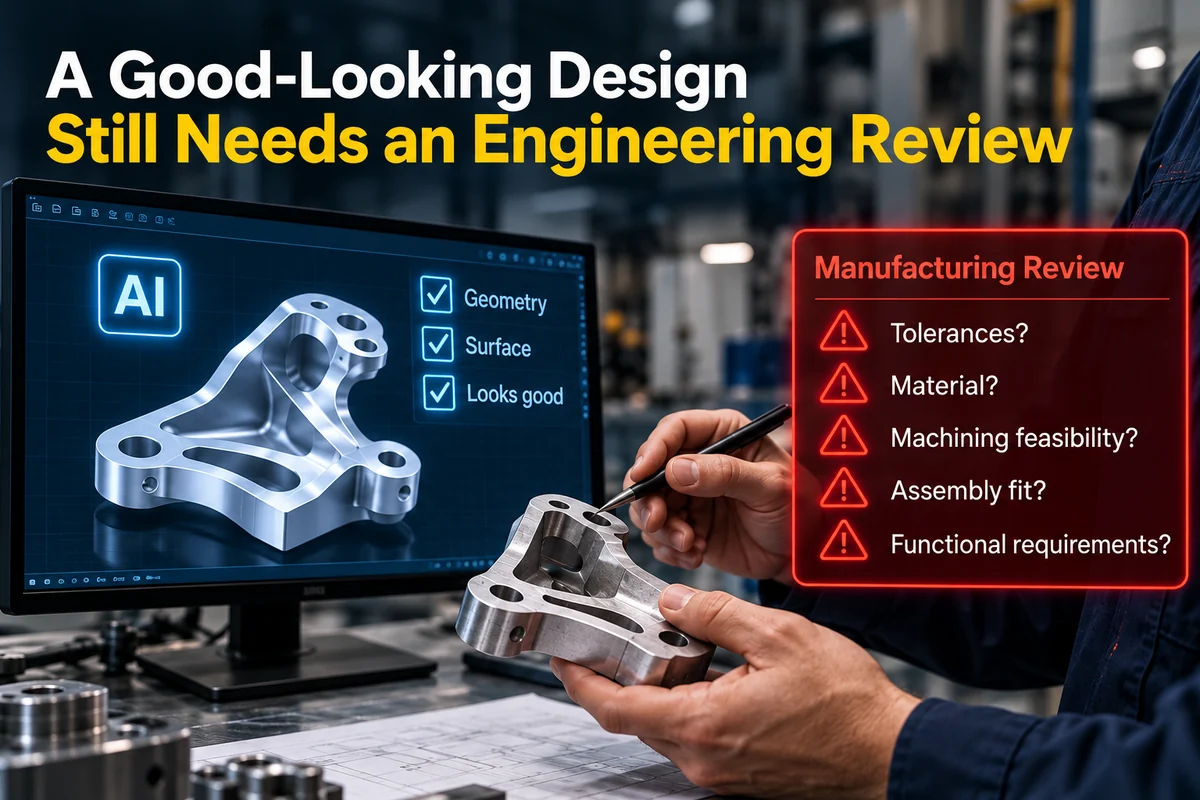
When an experienced engineer reviews a drawing, they're not only looking at the part itself. They're checking whether a feature can be held consistently on the equipment available, whether tool wear will cause dimensions to drift over a production run, and whether stacked tolerances across several features will exceed what the assembly can tolerate. Those judgments come from process experience and familiarity with specific equipment capability — not something you can read off a model's geometry alone. It's also why our team runs a manufacturability review on every new drawing, regardless of where it came from, rather than quoting straight off the file — separating actual design intent from software defaults, and confirming material condition, critical tolerances, and manufacturability before moving forward.
The distance between an AI-generated sketch and a part that can be produced reliably at volume comes down to exactly these steps — and for now, they're still the part of the process AI can't do on its own.
AI Changes Design Speed, Not Manufacturing Judgment
None of this means AI-generated design has no value. Used well, it can help an engineer rule out obviously unworkable directions early and spend more time on the parts of a design that deserve real scrutiny. There are also tools emerging that build manufacturability checks directly into the design process, flagging issues while a part is still being modeled instead of waiting for a formal review. The real value of a tool like that is getting design constraints in front of engineers earlier — not replacing the judgment call itself.
At WorldSkills Conference 2026, held alongside the WorldSkills Shanghai competition, a session on AI's impact on the workforce reached a similar conclusion: AI is expected to take on more of the routine work, but tasks involving real-world judgment and verification still need people. That's the same dynamic we see in custom CNC work every day — AI can turn an idea into a complete-looking drawing quickly, but turning that drawing into a part that can actually be produced at volume still depends on someone confirming material condition, setting tolerances, and working out a viable process, one step at a time.
Conclusion
Whether an AI-generated design file is usable isn't a yes-or-no question. It's a reasonable way to communicate an early concept and move a conversation forward quickly. But between that file and a part that can be produced consistently, someone still has to confirm material, tolerances, and manufacturability — every time. Where the file came from matters less than whether those things were checked before production started.
Have an AI-Generated Design You Need to Get to Production?
If you're holding an AI-assisted or AI-generated design and getting ready to request quotes, send it to us first. Backed by more than 20 years in custom metal manufacturing, we can review material, critical tolerances, and manufacturability before you commit to a supplier — instead of quoting off every detail on the file as-is. This review carries no additional cost, and it's the first step we take on every project — it's also the easiest way to catch what could otherwise turn into a scrapped run or a rework cycle.
Discuss Your Project
Authoritative External Links / References
- Leo AI. AI-Generated CAD Models: Why Most Aren't Ready for Production (And What to Do About It). Read the article
- ASME. Y14.5-2018 (R2024): Dimensioning and Tolerancing. View the standard
- Quality Magazine. Design Now, Save Later: The Hidden Costs of Late-Stage Manufacturing Changes. Read the article
- WorldSkills Conference 2026. WorldSkills Shanghai 2026 Outlines a Human-First Approach to AI. Read the article
 Have a Custom Manufacturing Project?