CNC Machining vs Die Casting: When Does It Make Sense to Switch?
CNC works well for prototypes and changing designs; die casting can win at scale. Compare tooling, part design, materials, post-machining and lifecycle cost before switching.
CNC works well for prototypes and changing designs; die casting can win at scale. Compare tooling, part design, materials, post-machining and lifecycle cost before switching.
Many aluminum parts start with CNC machining during product development. It requires no dedicated forming die, design changes are relatively easy to absorb, and it works well for prototypes, low-volume builds, and parts whose dimensions or architecture are still evolving.
The process decision becomes more important once demand starts to scale. Staying with CNC means machining time, material removal, and machine occupancy continue with every part. Moving to high-pressure die casting (HPDC) adds tooling, trials, and engineering validation up front. The useful question is therefore not simply, “Which process is cheaper?” but, “Which manufacturing route makes more sense over the full life of this part?”
In this article, “die casting” refers mainly to conventional high-pressure die casting (HPDC), not gravity casting, low-pressure casting, or squeeze casting.
CNC usually has a lower upfront commitment, but every part continues to consume spindle time, tooling, workholding, and machining capacity. HPDC works the other way around: the tooling and validation investment is higher, but once the design and process are stable, repeated production can spread that fixed cost over a larger number of parts.
| Factor | CNC Machining | High-Pressure Die Casting |
|---|---|---|
| Upfront investment | Lower; mainly programming, fixtures and first-article work | Higher; die, trials and engineering validation |
| Design changes | Relatively flexible | More expensive after tooling is built |
| Per-part production | Cut individually; machining time remains significant | Cyclic production after the die is validated |
| Material range | Broad | Limited to suitable die-casting alloy systems |
| Precision functional features | Can be machined directly | Often reserved for secondary CNC |
| Best fit | Prototypes, lower volume, changing designs | Stable designs with repeat production |
That is why there is no universal production quantity at which a part “should” switch to die casting. A simple early-stage break-even model is:
Break-even quantity ≈ (HPDC fixed cost − CNC fixed cost) ÷ (CNC variable cost/part − HPDC variable cost/part)
For illustration, assume CNC programming and fixtures cost $1,000 up front, while HPDC tooling and engineering cost $30,000. If the die-cast route reduces variable cost by $8 per part, the theoretical break-even point is about 3,600 parts. This is only a cost-model example, not a market benchmark or a fixed quotation threshold. If the design is still changing or the casting still requires extensive machining, crossing that number does not automatically make tooling the better decision.
A part designed around CNC can tolerate deep pockets, vertical walls, local heavy sections, and substantial stock removal as long as tools can reach the features and the workpiece can be held securely. HPDC has a different set of constraints: metal flow, wall transitions, fillets, draft, parting, venting, and ejection all influence the result. A CNC drawing therefore should not be treated as a die-casting-ready design by default.
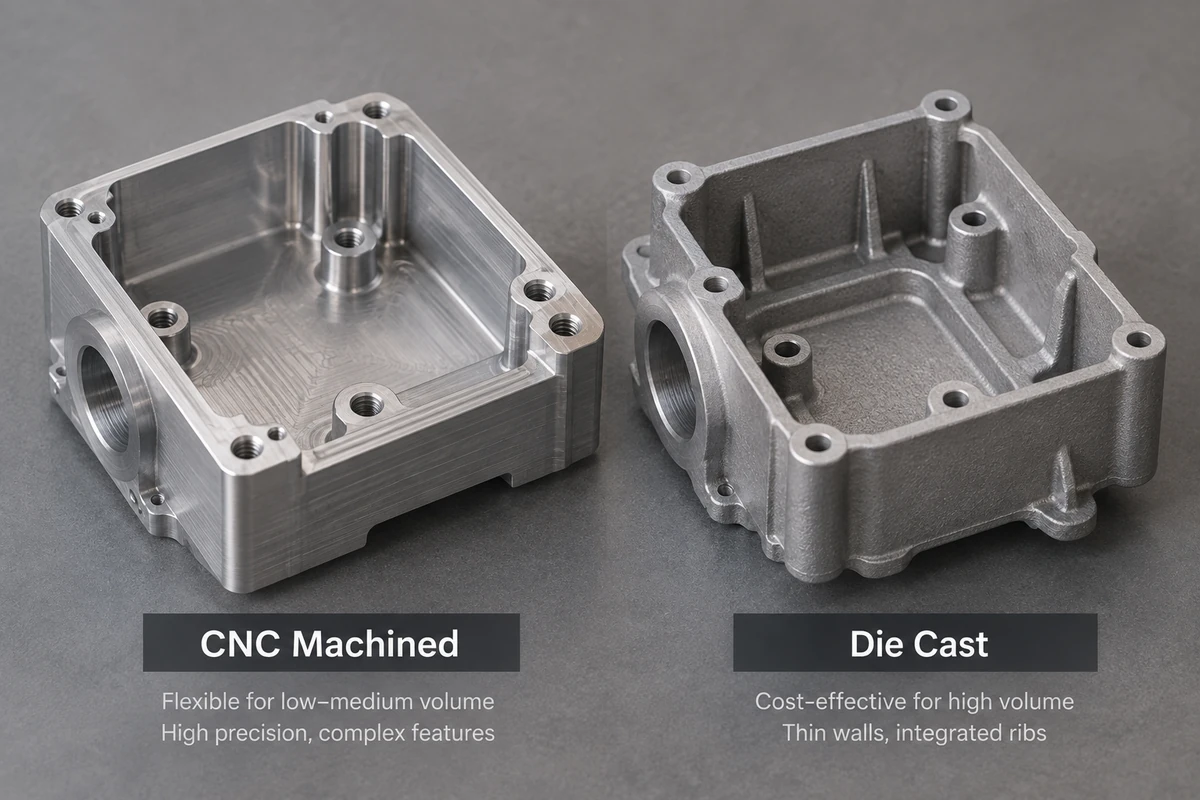
When a machined part is redesigned for HPDC, heavy sections may become ribs or more uniform walls, abrupt thickness changes may need smoother transitions, and the parting line, ejector locations, draft, and secondary-machining areas may all change. If the “converted” part still needs large amounts of stock removal, multiple setups, and broad precision machining, the bigger opportunity may be redesigning the part rather than simply changing the raw-forming process.
This is consistent with NADCA design guidance, which highlights uniform wall thickness, draft, fillets, and metal-flow considerations as core die-casting design factors.
HPDC is efficient at forming complex near-net-shape geometry, but bearing seats, sealing faces, locating holes, critical mounting surfaces, and some threads may still need CNC to meet final functional requirements. In a production design, that is not a process failure. It is a deliberate division of work: casting creates most of the geometry, while CNC is concentrated on the features where precision directly affects assembly or performance.
This route also makes internal quality more important. If a sealing face, deep hole, or other critical region will be machined later, the quality requirement for that area should be considered during die and process development. Otherwise, a casting that looks acceptable and meets external dimensions may expose porosity only after material is removed.
An industrial study onaluminum RF filter housings illustrates the point. The component had previously been produced by high-speed machining. As production demand increased, the project moved toward HPDC with a redesigned component and die; the production tooling was subsequently used over a run of roughly 30,000 parts. That number is not a universal switching threshold. The useful lesson is that the change happened after the design, production need, and die-casting process were developed and validated together.
CNC and HPDC commonly use different aluminum alloy families. Wrought alloys such as 6061 and 7075 are common machining choices, while high-pressure die casting typically uses alloys developed for castability, filling behavior, and solidification control. A “6061 CNC part” therefore cannot be converted by simply pouring the same geometry in a die.
A process change should trigger a fresh review of strength and stiffness, thermal performance, sealing requirements, surface finishing, threads and press-fit regions, and any areas that will be deeply machined. The better approach is to select the material and manufacturing route around the functional requirements, rather than forcing the casting to reproduce the original CNC material and geometry exactly.
CNC is often the safer route when the product is still being developed, design revisions are frequent, or future demand is uncertain. It can also remain the better choice when the part requires a specific high-strength wrought alloy, the geometry is a poor match for die casting, or most functional surfaces still need precision machining. For parts already optimized around CNC, increasing volume alone does not justify tooling; if the casting still requires extensive stock removal and secondary operations, the tool investment may not deliver a meaningful reduction in total manufacturing cost.
HPDC becomes more attractive when the design is substantially frozen, repeat demand is credible, and the part can use the process to form housings, ribs, bosses, thin walls, or other integrated geometry. The strongest candidates are parts where casting can eliminate a meaningful amount of CNC stock removal while leaving only a limited number of critical features for secondary machining.
A practical development path is: CNC prototype validation → die-casting DFM review → die design and trials → design refinement → HPDC production → CNC finishing of critical features → inspection.
In other words, the process transition is usually gradual and engineering-led, not triggered by a single order-quantity number.
When CNC and HPDC quotations are compared side by side, the lowest unit price does not necessarily identify the lower-cost program.
| Cost / Risk Item | CNC | HPDC |
|---|---|---|
| Engineering / programming | Yes | Yes |
| Fixtures | May be required | May be required for secondary machining |
| Production die | No | Yes |
| Samples / first article | Yes | Yes, including die trials |
| Per-part cost | More sensitive to machining time | Often more favorable at repeat volume |
| Secondary CNC | Primary process | Depends on critical features |
| Design-change risk | Lower | Higher after tooling |
| Internal quality control | More direct | May also require porosity / leak control |
| Long-term maintenance | No die maintenance | Die maintenance must be considered |
The more useful comparison is total lifecycle cost: whether the tooling can be amortized across realistic demand, how stable the design is, how much secondary machining remains, and how likely future engineering changes are.
CNC machining and high-pressure die casting are not simple substitutes. CNC is well suited to development, lower volumes, and designs that are still changing. HPDC becomes more compelling once the design is mature, repeat demand is credible, and the geometry can take advantage of the process.
For many production aluminum parts, the most efficient route is not one process or the other: the casting forms the main structure, while CNC protects the dimensions that actually control function. When volume starts to rise, three questions are more useful than asking for a universal tooling threshold: Is the design stable? Is the geometry genuinely suited to HPDC? Will tooling plus secondary CNC reduce lifecycle cost?
If your project is moving from prototypes or low-volume builds toward repeat production, our CNC machining, high-pressure die casting, and production and quality control capabilities can be reviewed together to determine whether changing the raw-forming route actually makes sense.
 Have a Custom Manufacturing Project?
Share your drawing, 3D model, material, tolerance, finish, and expected quantity. Tongyong Industries can review your requirements and suggest a practical manufacturing solution.
Faq
There is no universal volume threshold. Compare fixed tooling and engineering costs, variable cost per part, expected lifecycle demand, and design stability. If the part is still changing or still needs extensive CNC after casting, higher volume alone may not justify tooling.
Casting and machining can serve different functions. HPDC efficiently creates the main geometry, while sealing faces, bearing seats, locating holes, critical mounting surfaces, and other functional features may be left with machining allowance and finished by CNC.
Not as a general rule. A machined part inherits the properties of its wrought alloy and temper, while a die-cast part depends on casting alloy, geometry, and casting quality. Compare the actual strength, stiffness, ductility, thermal, and environmental requirements rather than the process label alone.
Usually not. 6061 is a common wrought aluminum alloy, while HPDC typically uses alloys selected for filling and solidification behavior. The conversion also requires a fresh review of wall thickness, fillets, draft, parting, ejection, and secondary-machining areas.
Get Started Today
Upload your drawings and specifications. Our engineers will review and respond with an engineering review within 24 hours. All inquiries are treated with strict confidentiality.
We use cookies to collect information about how you use this website. We use this information to optimize website functionality and improve our services. Privacy Policy