Why Aluminum Die Casting Cost Is Often Misunderstood
If you have ever sent the same aluminum part drawing to several suppliers and received very different quotations, the difference is usually not just margin.
Aluminum die casting cost is shaped by several decisions that are made before production begins: the mold structure, alloy selection, number of cavities, part weight, cycle time, CNC post-machining, surface finish, inspection level, annual volume, and even how stable the design is.
That is why asking “How much does die casting cost?” rarely leads to a useful answer. A better question is:
At what production volume does aluminum die casting become the most practical way to manufacture this part?
For low-volume or still-changing designs, CNC machining may be easier to manage. For stable parts with repeat demand, die casting can reduce the unit price significantly because the tooling investment is spread across many parts.
This guide explains what buyers are really paying for, why die casting tooling cost feels high at the beginning, and how to reduce unnecessary cost before the mold is built.
The Short Version: What Drives Die Casting Cost?
A die casting quotation normally includes two very different cost structures.
The first is the upfront tooling cost. This covers the die, inserts, sliders, ejector system, cooling channels, trial runs, and mold adjustments.
The second is the recurring per-part cost. This includes aluminum alloy, shot weight, machine time, cycle time, trimming, labor, CNC post-machining, surface finishing, inspection, and packaging.
In simple terms:
Aluminum die casting cost = tooling investment + per-part production cost + secondary operations
For buyers, the important point is not only the price of one casting. It is how the tooling cost, production volume, and finishing requirements work together.
A part with a low unit price may still require a large mold investment. A part with a modest mold cost may become expensive if it needs too much CNC machining after casting.
Why Die Casting Tooling Cost Is Usually the First Big Number
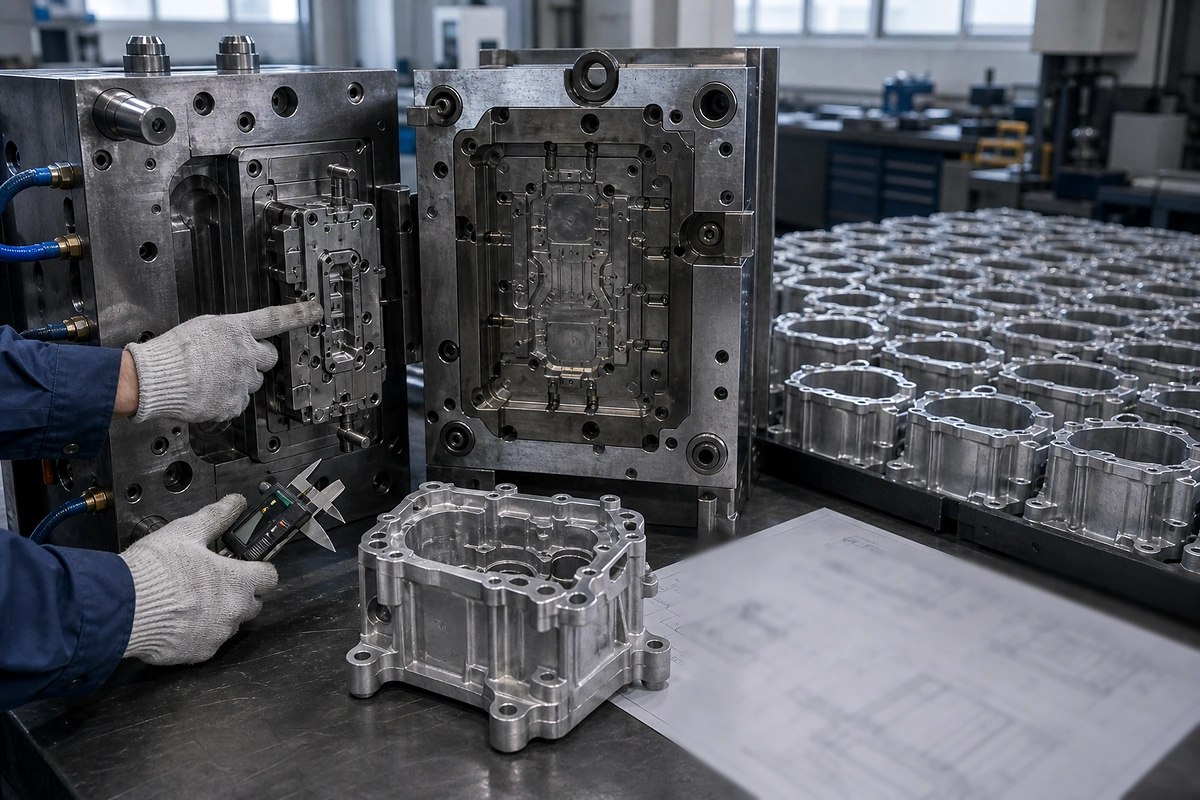
A die casting mold is not just a shaped cavity cut into steel.
It has to withstand heat, pressure, repeated clamping force, metal flow, ejection, and production cycles while keeping the part dimensions stable. Depending on the product, the tool may include slides, inserts, cores, ejector pins, gates, vents, cooling lines, and trimming tools.
Two aluminum parts with similar weight can have very different die casting mold cost.
A simple open-and-shut housing may need a relatively straightforward tool. A thin-wall enclosure with side holes, sealing faces, cosmetic surfaces, undercuts, and tight post-machining requirements will need a more complex mold.
Common tooling cost drivers include:
-
Large projected area requiring a larger die casting machine
-
Side holes or undercuts requiring sliders
-
Thin-wall areas that are difficult to fill consistently
-
Deep ribs or pockets
-
Tight as-cast tolerance requirements
-
Cosmetic surfaces that require careful parting line and gate planning
-
Complex parting lines or shutoff areas
-
Multi-cavity tooling
-
Longer expected die life for repeat production
The lowest mold price is not always the lowest total cost. A weak or poorly planned die can create flash, unstable dimensions, porosity risk, short tool life, repeated repair work, and production delays.
For a real production part, tooling quality is part of the cost strategy.
Tooling Amortization: Why Volume Changes the Unit Price
Die casting tooling is usually paid once, but the cost is recovered through the parts.
For example, if a mold costs $15,000:
| Production Volume |
Tooling Cost per Part |
| 5,000 parts |
$3.00 |
| 50,000 parts |
$0.30 |
| 150,000 parts |
$0.10 |
The mold itself did not become cheaper. The production plan changed.
This is why aluminum die casting may look expensive for a first order but attractive for repeat production. When the design is stable and the annual demand is clear, tooling amortization can make the unit price much easier to justify.
This is also why a serious supplier will ask about both first order quantity and annual volume. A quote based only on the first order may not reflect the real cost structure of the project.
Die Casting vs CNC Machining: Where the Cost Crossover Happens
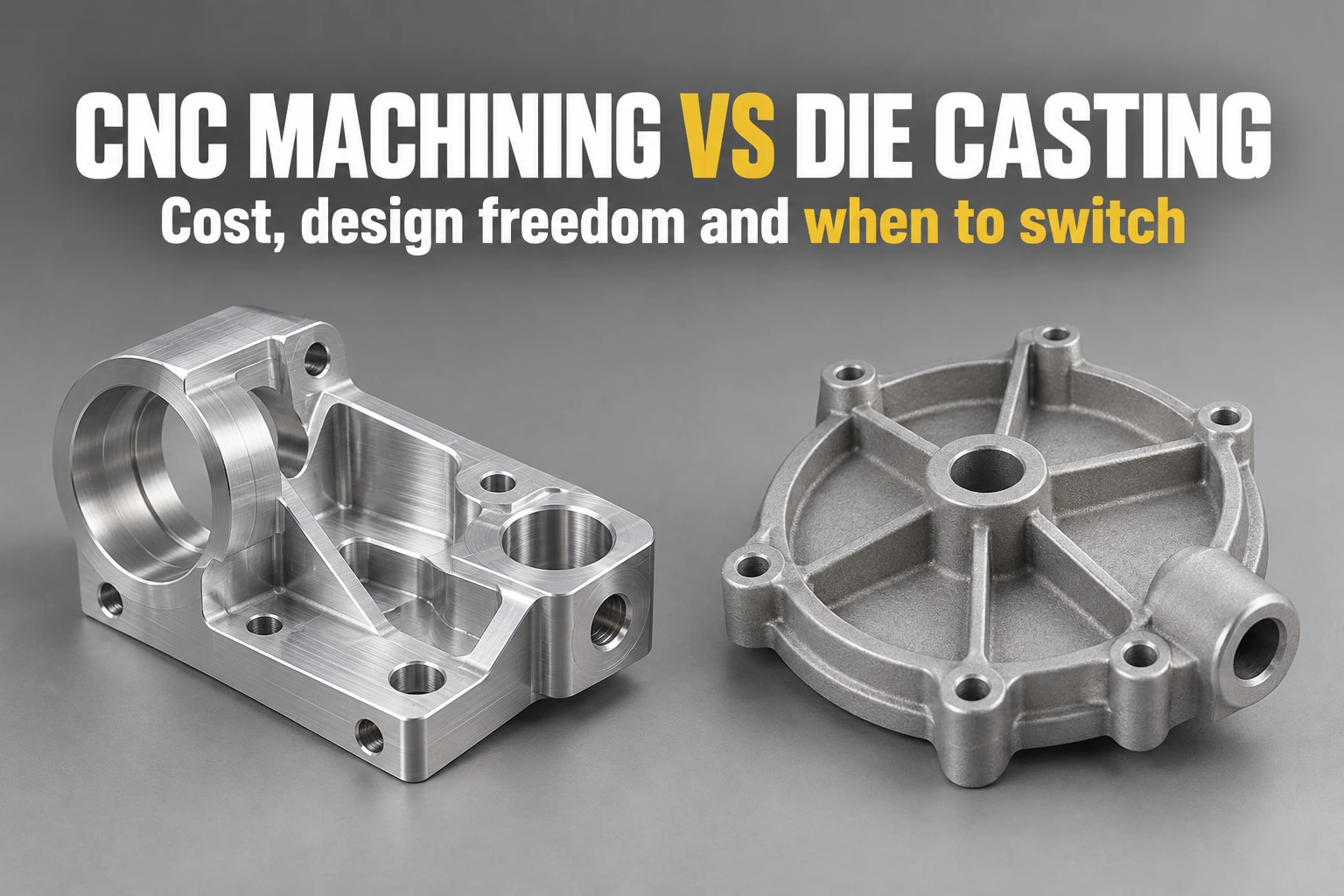
CNC machining and die casting are not competing in every situation. They solve different manufacturing problems.
CNC machining is flexible. It is usually the better choice for prototypes, early samples, low-volume builds, and designs that may still change. You can adjust the CAD file and machine the next version without investing in a production mold.
Die casting requires more commitment upfront. Once the mold is built and the process is stable, however, it can produce aluminum parts repeatedly with much lower labor and machine time per part.
The cost crossover depends on part size, geometry, tolerance, secondary machining, surface finish, and mold cost.
A practical way to think about it:
| Production Situation |
Likely Process Fit |
Why |
| 1–100 parts |
CNC machining |
No die is needed, and design changes are easy. |
| 100–1,000 parts |
Usually CNC or prototype casting |
The design may still be under development. |
| 1,000–5,000 parts |
Case by case |
Geometry, tolerance, finishing, and tooling cost decide the answer. |
| 5,000+ parts per year |
Often worth reviewing for die casting |
Tooling can begin to make sense if the design is stable. |
| 20,000+ parts per year |
Strong die casting candidate |
Unit price and repeatability often become more important. |
These are not fixed rules. A small and simple part may justify tooling earlier. A large and complex casting may need much higher volume before it becomes economical.
The best decision usually comes from comparing the total cost, not just the quoted unit price.
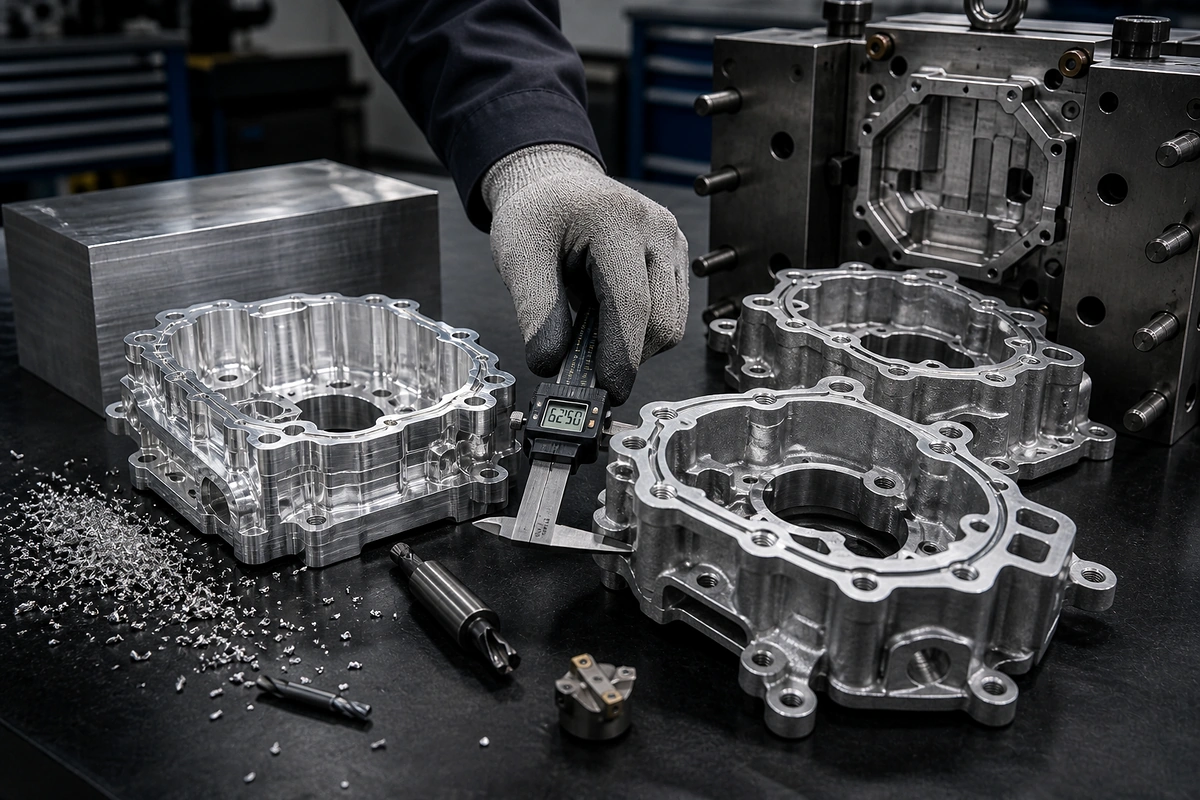
Design Choices That Increase Aluminum Die Casting Cost
Many cost problems are already built into the part before the supplier starts quoting. The best time to reduce die casting cost is before the mold is made.
Thick or uneven wall sections
Wall thickness affects filling, cooling time, shrinkage, porosity risk, and cycle time.
Very thick areas add material and slow cooling. Very thin areas may be difficult to fill. Sudden transitions between thick and thin sections can increase defect risk.
A good design does not always require every wall to be identical. Real parts often need variation. But gradual transitions, ribs instead of solid blocks, and well-placed radii usually help the casting fill and cool more predictably.
Missing draft
Draft helps the casting release from the die.
Without enough draft, the part may drag, stick, deform, or require more aggressive ejection. This can affect surface quality, die wear, and production stability.
Draft should be considered early, not added reluctantly after the design is already frozen.
Tight tolerances on every surface
Tight tolerances should be used where the part function requires them.
If every surface is marked as critical, the supplier may need more precise tooling, tighter process control, more inspection, and additional CNC machining after casting.
A cost-conscious drawing separates:
This tells the supplier where precision is truly needed and where standard die casting control is acceptable.
Undercuts, side holes, and sliders
Undercuts and side holes can require slides, lifters, or other mold actions.
These features increase tooling cost and maintenance requirements. Sometimes a small design change, such as moving a hole, changing a rib, or adjusting the parting line, can remove a slide completely.
That kind of change can reduce die casting tooling cost without weakening the part.
Too much CNC post-machining
Die casting is valuable because it creates a near-net-shape part.
If the casting is then machined on every side, much of that advantage disappears. CNC machining after die casting should normally be reserved for functional features such as:
-
Threads
-
Sealing faces
-
Bearing seats
-
Precision holes
-
Flat mounting surfaces
-
Critical datums
The goal is not to avoid CNC machining completely. The goal is to use it only where it adds real functional value.
Cosmetic surfaces that are not clearly defined
Visible surfaces need to be planned before tooling.
Gate location, parting line, ejector pin marks, polishing direction, coating requirements, and inspection criteria all affect cost. If the cosmetic standard is unclear, the quote may either be too optimistic or too conservative.
For appearance-critical aluminum die cast parts, customers should clearly mark the visible surfaces and define the acceptable finish level.
Secondary Operations Can Quietly Change the Price
Many buyers focus on the casting price and overlook the cost of everything that happens after casting.
Common secondary operations include:
Trimming · Deburring · Shot blasting · CNC machining · Drilling · Tapping · Polishing · Anodizing · Powder coating · Plating · Leak testing · Assembly · Dimensional inspection · Packaging
These operations may be necessary, but they should be planned from the start.
For example, a part with several threaded holes may need tapping after casting. A housing with sealing surfaces may need CNC machining. A consumer-facing part may need polishing, coating, and stricter cosmetic inspection.
This is why an aluminum die casting price should not be judged only by the casting line item. The real question is what the finished part will cost when it is ready for assembly.
What a Supplier Needs Before Giving a Useful Quote
A useful die casting quote needs more than a product name and target price.
To estimate the project properly, prepare as much of the following information as possible:
-
3D CAD file, preferably STEP or IGES
-
2D drawing with critical dimensions and tolerances
-
Target aluminum alloy, such as A380, ADC12, or another specified material
-
Expected annual volume
-
First order quantity
-
Part weight or estimated size
-
Required surface finish
-
Threads, holes, sealing faces, or features that need CNC machining
-
Cosmetic surface requirements
-
Application and load conditions
-
Assembly requirements
-
Inspection report or quality documentation requirements
-
Packaging requirements
If the design is not final, it is still worth sharing. A DFM review can often identify cost risks before they become mold changes.
Practical Ways to Reduce Die Casting Cost
There is no single trick that makes every die casting project cheaper. Cost reduction usually comes from several small design and process decisions.
The most useful actions are:
-
Keep wall thickness as consistent as the function allows.
-
Add draft early.
-
Use radii and fillets to improve metal flow.
-
Avoid undercuts unless they are necessary.
-
Mark only functional dimensions as tight tolerance.
-
Limit CNC post-machining to critical features.
-
Define visible cosmetic surfaces clearly.
-
Confirm annual volume, not just first order quantity.
-
Choose a finish that fits the real use environment.
-
Ask for DFM review before the mold quote is finalized.
The best die casting cost optimization usually happens before steel is cut.
Once the mold is already made, every change becomes slower, more expensive, and harder to control.
A Better Way to Compare Quotes
When comparing aluminum die casting suppliers, do not look only at the lowest number.
A stronger quote should explain:
-
What is included in tooling
-
Whether sliders, inserts, or trim tooling are included
-
What alloy is assumed
-
How many cavities are planned
-
What secondary operations are included
-
What CNC machining is required after casting
-
What finish is included
-
What inspection level is included
-
Whether packaging is included
-
What assumptions are made about volume
If a supplier can only provide a number but cannot explain the cost drivers, the quote may not be reliable enough for a production decision.
FAQ
How much does aluminum die casting cost?
It depends on tooling, alloy, part weight, cycle time, cavity count, tolerance, surface finish, inspection, and production volume. For early planning, separate the one-time mold cost from the recurring per-part cost.
Why is die casting tooling expensive?
The die is a precision steel tool designed for high temperature, pressure, and repeated production cycles. It may include cavities, sliders, inserts, cooling channels, ejector pins, gates, vents, and trimming tools.
Is die casting cheaper than CNC machining?
At low volume, CNC machining is often more economical because it avoids production tooling. At higher volume, die casting can become more cost-effective because the mold cost is spread across many parts.
What production volume justifies die casting?
There is no universal number. Die casting becomes more attractive when the design is stable and annual demand reaches thousands of parts. Geometry, tolerance, finishing, and tooling cost must all be reviewed.
Need a Cost Review for Your Aluminum Die Casting Part?
Tongyong Industries supports global B2B customers with custom metal parts manufacturing, including aluminum die casting, CNC machining, surface finishing, and assembly support.
If you are comparing die casting vs CNC machining, or if you want to reduce tooling cost before production, send us your drawing, 3D file, target quantity, material, tolerances, and surface finish requirements.
Even if your project is still at the concept stage, our team can help review the design, identify cost drivers, and suggest a practical manufacturing route before tooling begins.
Get a Die Casting Cost & DFM Review
 Have a Custom Manufacturing Project?