Why Choose Fiber Laser Marking for Metal Parts?
Changing serial numbers, small markings and durable IDs put different demands on metal parts. See when fiber laser marking helps, and what to check before ordering.
Changing serial numbers, small markings and durable IDs put different demands on metal parts. See when fiber laser marking helps, and what to check before ordering.
Fiber laser marking advantages include putting text, graphics and variable codes directly on metal parts, with less reliance on labels, inks or contact engraving tools. It is worth comparing for parts that need individual serial numbers, small details or identification that remains readable in service.
Whether these advantages help your order depends on the material, its surface finish, the appearance you need and the conditions of use. This guide helps engineers and buyers of metal parts assess the benefits, compare other marking methods and define what to check on samples.
Fiber laser marking focuses a beam on the material to change its local color or surface structure. It can also remove material to create a recessed mark. Fiber describes the laser source; marking describes its purpose. A fiber laser system can support different marking processes, with results depending on the equipment and settings.
Common near-infrared fiber laser systems can be evaluated for surface marking and engraving on many metals. Metals, plastics and glass need separate consideration when choosing a laser type. Heat-sensitive requirements may call for different pulse characteristics or another type of laser. Digital control and non-contact processing are also features of other laser marking systems; they are not exclusive to fiber lasers.
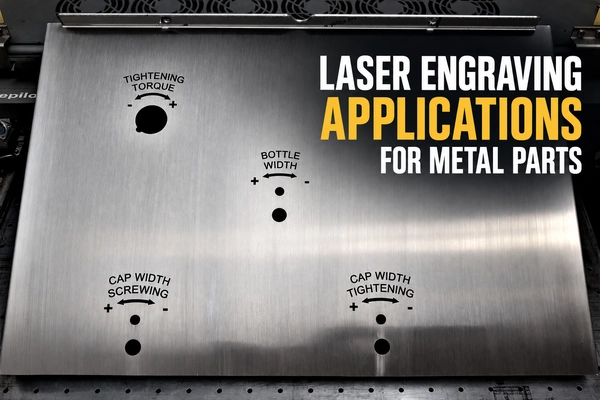
For example, a model number may need only clear contrast, while an identification number exposed to wear may call for a recessed mark. A coated cosmetic part needs a decision about whether the mark may alter the coating. Describe the required result when requesting a quote. Our guide to laser engraving applications for metal parts explains how marking tasks differ.
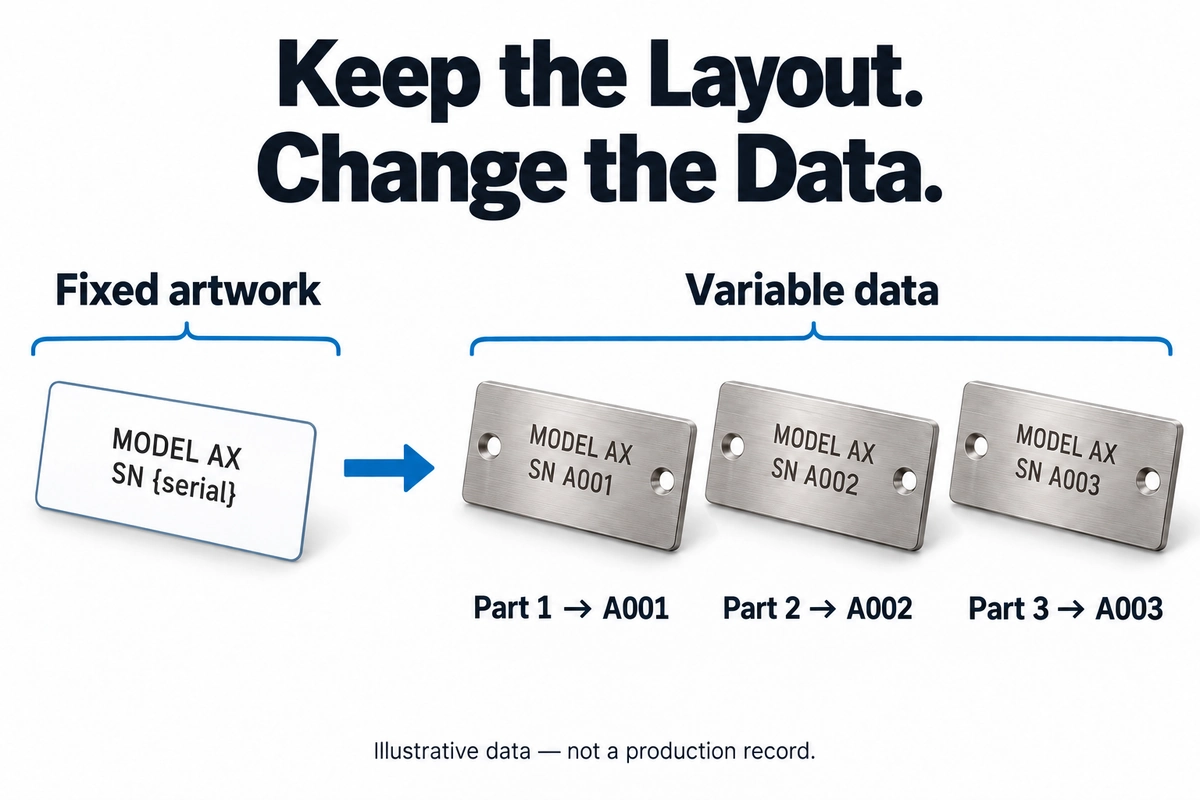
Batch numbers, dates and serial numbers change from part to part. Digital control lets the marking layout and position stay consistent while the variable content changes. Compared with methods that require a separate physical template for each design, this makes individual part identification easier to organize.
Separate the fixed artwork from the variable data when handing over the job. The artwork defines the text area, orientation and position on the part; the data file defines what each number should contain. At a batch change, check the data revision, starting and ending numbers, and rules for handling duplicates. These controls turn quick text changes into reliable batch delivery.
Fiber lasers can produce small text, logos and machine-readable codes on metal parts with limited marking space. Check that lines or code cells remain distinct, that character spacing is suitable and that the surrounding area needed for reading is clear. Reduced artwork must still be legible or readable under the intended conditions.
Check cosmetic text under the expected lighting and viewing direction. Check QR or Data Matrix codes using the actual or agreed reading conditions. Glare, rough textures and curved surfaces can affect results. As Cognex explains in its barcode verification guide, decoding a symbol and assigning a specified quality grade are different tasks. If the contract requires a grading report, agree on the verification method and records separately.
Fiber laser marking does not indent the surface with a pin or apply the cutting forces of a rotating tool. This can reduce mechanical loading during marking on thin sheet or cosmetic parts. The fixture must still hold the part securely to prevent movement or a shift in position.
Laser processing still introduces heat. For thin walls, precision mating surfaces or heat-sensitive areas, define where marking is allowed, whether material may be removed and which changes in shape or surface condition need inspection.
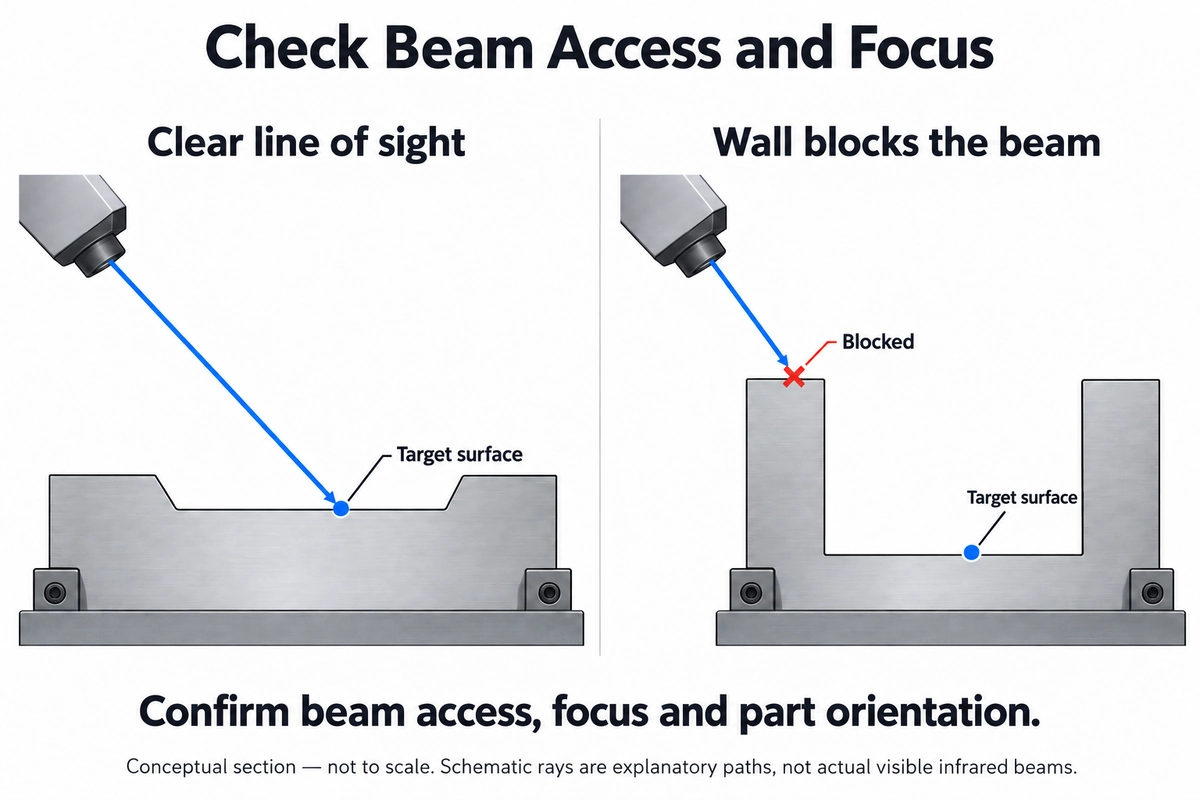
Also check whether the beam can reach the intended surface. For marks at the bottom of a recess, on a sidewall or on faces at different heights, ask the supplier to check for beam obstruction, correct focus at the target surface and any need to change the fixturing orientation.
A mark formed directly on the part needs no label adhesive and can eliminate ink replenishment for that marking operation. This can be useful for parts that are wiped frequently, handled regularly or need identification over a long service period. Check durability against the expected abrasion, cleaning agents and corrosion environment. The result also depends on whether the mark is in the substrate, an anodic layer or another coating.
For a cost comparison, request a quote covering marking, fixturing, data checks, inspection and necessary cleaning. Laser systems still require optical maintenance, fume management and supporting supplies. Subcontract prices may also include first-piece approval and batch setup. Compare quotes with the same delivery requirements to see whether reduced labeling or ink work creates an overall benefit.
Different methods suit different tasks. The comparison below starts with common purchasing requirements for metal parts, rather than treating one method as the default for every application.
| Main requirement | Methods to compare | What to check |
|---|---|---|
| Frequently changing serial or batch data | Fiber laser, variable-data labels or printing | Part-to-data matching, batch changes and reading requirements. |
| Multicolor panels, large color areas or complex graphics | Screen printing, printed labels, or a combination with local laser marks | Colors, adhesion, wipe resistance and artwork change frequency. |
| Fine text and direct part codes in limited space | Fiber laser and, where needed, other laser processes | Artwork size, surface glare, surrounding clear space and actual reading results. |
| Simple numbers with a pronounced indentation | Dot peen, mechanical engraving or laser engraving | Allowed depth, surface roughness, part support and complete processing time. |
| Replaceable information | Removable labels or separate nameplates | Replacement method, service environment and whether adhesive residue is acceptable. |
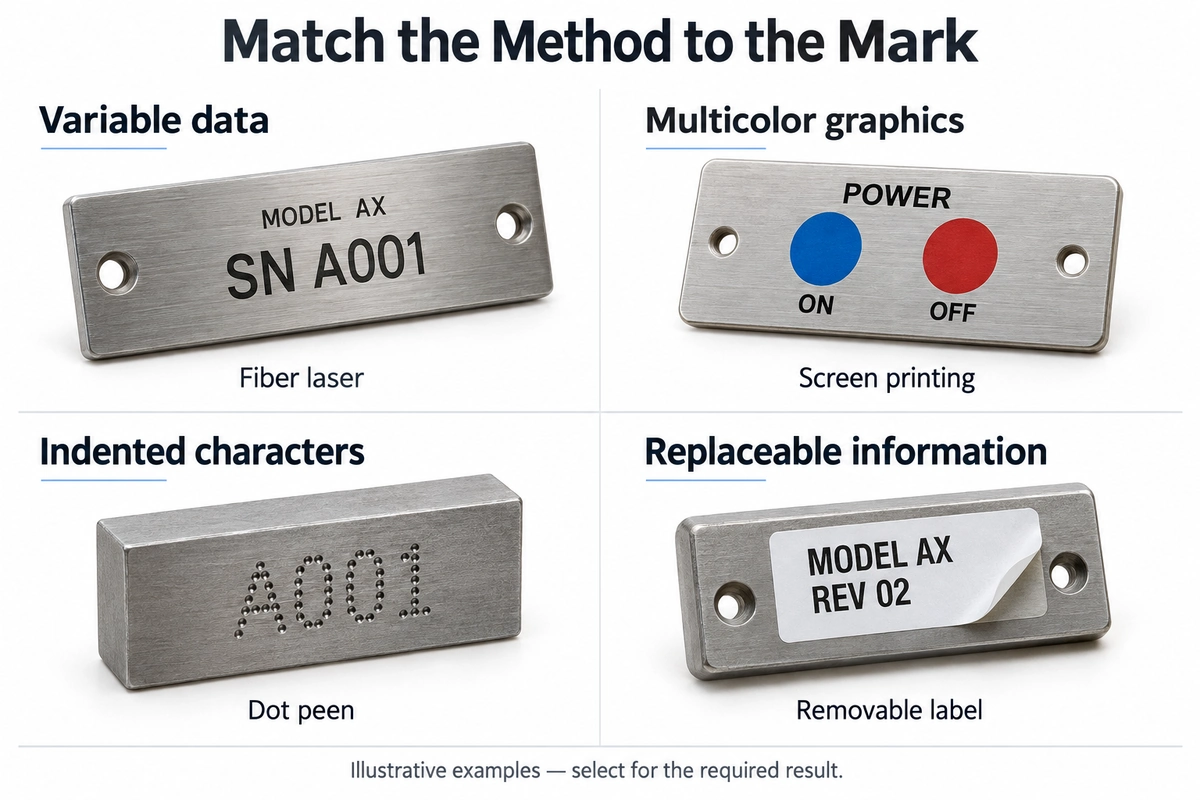
Dot peen can also produce durable part identification. Gravotech describes dot peen and scribing as direct marking methods. They are worth comparing with laser marking for a few simple characters where indentation is acceptable. For fine graphics or appearance-sensitive parts, focus the comparison on edge definition, surface changes and readability.
For production efficiency, compare the complete part cycle: loading, locating, marking, data checks, unloading and changeover. Large filled areas, deep engraving, multiple faces or difficult fixturing can add time. Scanner speed alone does not establish the delivery rate for finished parts.
Bare aluminum, anodized aluminum and painted aluminum can require different marking approaches. Specify the alloy and finish, and provide samples close to the delivery condition. For cosmetic approval, include the background color, texture and desired mark so that contrast and consistency can be assessed.
Choose the process sequence around the required result. If the mark creates contrast in a coating, evaluate marking after finishing. If a recess must remain in the substrate, check whether later coating or polishing will fill, cover or alter its edges. A general instruction to mark before or after finishing will not suit every part.
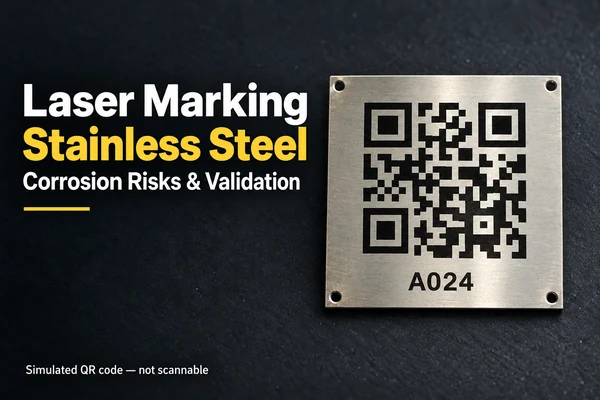
For stainless steel that faces frequent cleaning, moisture or defined corrosion requirements, include the marked area in the assessment. A dark appearance does not establish corrosion resistance. See our article on laser marking and stainless steel corrosion resistance for the relevant conditions and checks.
Choose samples that reflect differences the order will actually contain. For a job with a fixed logo and individual numbers, check both the logo position and the changing data across several parts. On a visibly textured surface, examine readability from different directions. These are sample-selection examples, not results from a completed customer project.
| Check | What to examine on the sample |
|---|---|
| Appearance and position | Check text, background, contrast and location under the agreed lighting, viewing direction and installed orientation. |
| Part surface | Check engraving, coating changes and local heat effects for the application; assess function separately at thin walls or mating areas. |
| Variable data | Check number content, sequence rules, matching to physical parts and handling of wrong or duplicate numbers. |
| Durability and reading | Check the agreed wiping, wear or environmental requirements. Define the reading or grading scope separately for machine-readable codes. |
After sample approval, retain the artwork revision, marking position, actual material and finish, approved appearance and acceptance method with the order. If the material or finish changes, decide which requirements need new samples.
For projects that combine marking with part manufacturing, send Tongyong the drawings, marking files, material and finish requirements, quantity and service conditions, and contact us to discuss samples and any specific positioning, data or appearance requirements.
KEYENCE — Fiber Laser Marking Machines
Gravotech — Dot Peen Marking Machines & Scribing
Cognex — Barcode Verification 101 Understanding the Barcode Grading Process

Share your drawing. Let’s discuss how to make your part.
From prototypes to production.
Black or dark marks may be feasible on some aluminum materials and finishes, but bare and anodized aluminum can require different processes and produce different results. Provide the actual material, finish, background color and desired black appearance. Confirm contrast and viewing direction on samples. Specify coating integrity, color consistency and durability separately if required; black marking alone does not define them.
Not necessarily. MOPA stands for master oscillator power amplifier. Systems with suitable controls can vary pulse width and other parameters, offering more process choices for the material and appearance. When buying marked parts, define the surface effect, whether a recess is allowed, heat-related requirements and durability first. The supplier can then assess the equipment and process. The MOPA name alone does not guarantee a particular black mark or suitability for every material.
Do not transfer the process without assessment. Materials respond differently to lasers, and plastics also vary with resin, color and additives. Common near-infrared fiber lasers are not a general solution for marking transparent glass. For products with metal and nonmetal parts, provide separate material samples and appearance requirements. Compare UV, CO₂ or other suitable processes where needed.
There is no universal answer. Individual numbering, fine artwork or less labeling work can make laser marking valuable. Other methods may suit simple fixed characters, large multicolor graphics or replaceable labels. Align quantity, marked area, engraving depth, fixturing, data checks and acceptance scope before comparing the full delivery cost.
Get Started Today
Upload your drawings and specifications. Our engineers will review and respond with an engineering review within 24 hours. All inquiries are treated with strict confidentiality.
We use cookies to collect information about how you use this website. We use this information to optimize website functionality and improve our services. Privacy Policy