Metal Injection Molding vs. Die Casting: Choosing the Right Process for Your Part
MIM and die casting can both mass-produce metal parts — but the wrong choice wastes tooling spend. Compare material, precision, and volume economics to choose right.
MIM and die casting can both mass-produce metal parts — but the wrong choice wastes tooling spend. Compare material, precision, and volume economics to choose right.
"Should I use metal injection molding or die casting for this part?" It's one of the most common process-selection questions in early product development. Both processes rely on tooling for volume production, but the molding medium and the steps that follow are completely different: MIM injects a feedstock of metal powder and binder into a mold, then goes through debinding and sintering. Die casting injects molten metal into a mold under high pressure and cools it rapidly. Dig deeper and the differences in material range, achievable precision, and cost structure turn out to be significant. This article compares both processes across the factors that matter most, so you can point your project in the right direction early.
| Dimension | Metal Injection Molding (MIM) | Die Casting |
|---|---|---|
| Suitable materials | Stainless steel, low-alloy steel, titanium alloys, and other metal powder materials | Primarily aluminum, zinc, and magnesium alloys; copper alloys are also die-castable but involve different process conditions and cost |
| Typical part size / weight | Usually under 150–200 mm; weight mostly 0.1–300 g, most commonly 1–50 g (a typical economic range — actual limits vary by supplier equipment) | Wider size range, covering small to fairly large parts; weight from a few grams to several kilograms |
| Dimensional tolerance | Typically ±0.3%–0.5% (e.g., a 25 mm dimension corresponds to roughly ±0.075–0.125 mm) | Linear dimensions within a single die half: Standard tier for Al/Mg/Zn is roughly ±0.25 mm for the first 25.4 mm, plus ±0.025 mm per additional 25.4 mm; Precision tier starts around ±0.05 mm for the first 25.4 mm. Dimensions crossing a parting line, slide, or moving core require additional tolerance |
| Surface finish | Good surface finish after sintering; fine detail reproduces well | Good surface finish; strong forming capability for large, thin-wall parts |
| Volume economics | After upfront tooling investment, per-part cost advantage typically emerges at mid-to-high volumes, helping amortize tooling and front-end engineering costs | Generally better suited to large-volume production; per-part cost drops further as volume scales |
| Typical applications | Medical devices, electronic connectors, precision structural parts | Automotive structural parts, consumer electronics housings, hardware structural components |
MIM figures reflect general industry guidance (source: MIMA/MPIF public design references). Die casting precision figures reference NADCA's published Product Specification Standards and apply only to dimensions formed within a single die half, without involvement of moving die components. Dimensions crossing a parting line, slide, or moving core require additional parting-line or moving-component tolerance. NADCA standards are periodically revised — refer to the current edition or your engineering team's evaluation for confirmation. Actual tolerance capability and volume/cost break-even points vary by part design, material choice, and manufacturing partner; final figures should come from a process evaluation.
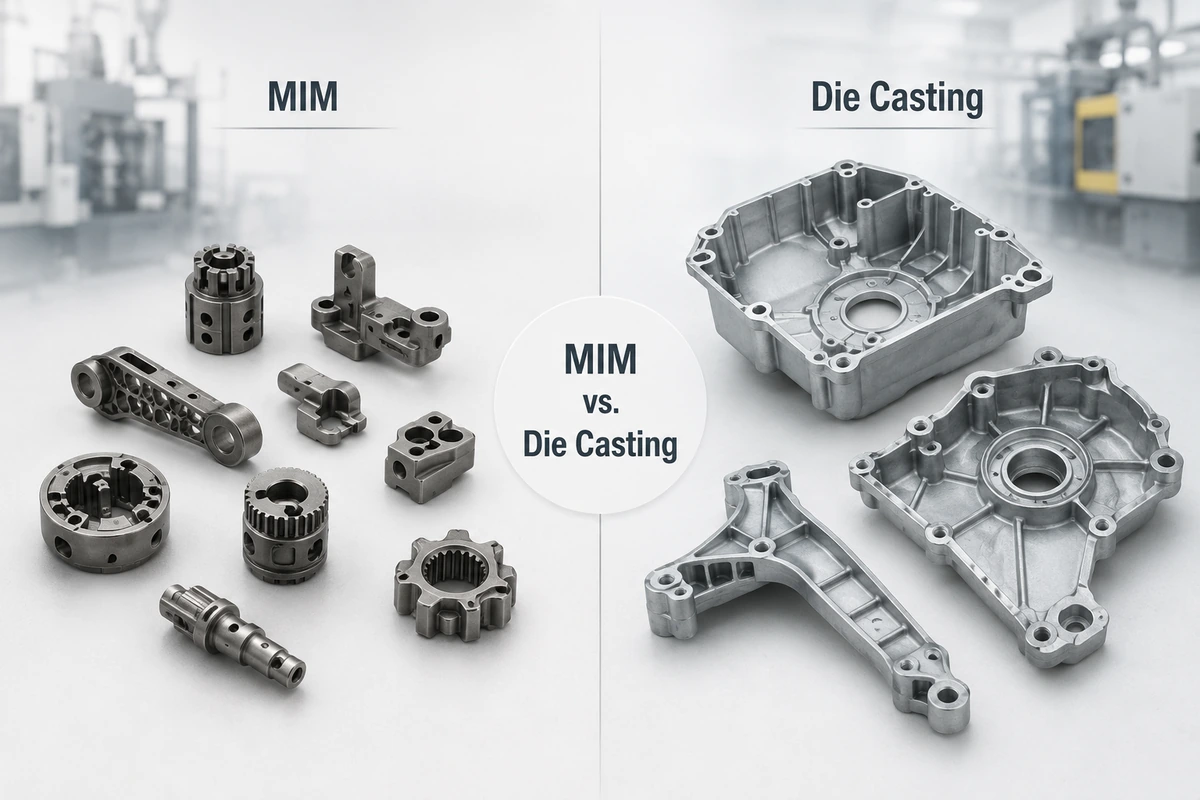
Looking at this table, you might notice something counterintuitive: comparing tolerance as a percentage, die casting's precision tier isn't necessarily far behind MIM's in some size ranges — and can sometimes be tighter. The real difference usually isn't about which process is "more precise" as a single metric. It comes down to how part size range, material properties, and structural complexity combine to determine which process performs better overall. In short: MIM's real advantage lies in small, geometrically complex parts, high-strength materials like steel, stainless steel, and titanium, and part consolidation at high volumes. Die casting's real advantage lies in mainstream alloys like aluminum, zinc, and magnesium, a wider size range, thin-wall large parts, and very high production throughput. We'll unpack these below.
Metal injection molding blends metal powder with a binder into a feedstock, then shapes it much like plastic injection molding before debinding and sintering densify the part. It's especially suited to small, structurally complex parts that need high precision — we walk through the full process step by step in "What Is Metal Injection Molding (MIM)?" Die casting injects molten metal into a mold cavity under high pressure and cools it rapidly. It's commonly used for volume production in lower-melting-point metals like aluminum and zinc alloys, and suits parts ranging from simple to moderately complex across a wide size range.
MIM machinable materials lean toward high-strength, corrosion-resistant steels and titanium alloys, suited to applications with demanding material performance requirements. Die casting's mainstream materials are lightweight alloys like aluminum, zinc, and magnesium — copper alloys are also die-castable, but with different process conditions and cost. Die casting suits weight-sensitive applications or ones that benefit from good thermal conductivity, such as automotive structural parts and certain electronics enclosures.
As the table shows, comparing percentage-based tolerance alone, the two processes aren't as far apart as you'd expect — MIM's industry-published average dimensional tolerance is around ±0.3% (up to 0.5% in some ranges), while die casting under NADCA standards works out to roughly ±0.33% at Standard tier and ±0.13% at Precision tier for a dimension around 100 mm. One thing worth flagging: these two tolerance systems aren't a fully apples-to-apples comparison. MIM's percentage figure is calculated against overall final dimension, while die casting tolerance is calculated by alloy type, dimension length, and whether the feature crosses a parting line or moving component — split into Standard and Precision tiers, with Precision typically requiring more precise tooling and additional cost. What really gives MIM the edge on "precision, complex, small parts" is its ability — after sintering densification — to reproduce fine detail like internal structures and delicate features, not the raw tolerance number itself. Die casting's efficiency and overall performance stand out more on large, thin-wall parts with relatively simpler geometry. What tolerance either process can actually hit on your specific part still requires a process evaluation against your drawings.
MIM is best suited to small-to-mid-size parts, with weight typically ranging from 0.1 g to 300 g — most commonly 1–50 g — and dimensions generally under 150–200 mm. Die casting's range is noticeably wider, covering parts from a few grams to several kilograms. If your part's size is at or beyond MIM's typical capability, die casting or another process may be the better direction.
Both processes require upfront tooling, so both suit mid-to-high volume production rather than single units or very small batches. The general pattern: for structurally complex, high-precision small-to-mid parts, MIM's cost advantage typically shows up as volume climbs into the mid-to-high range, helping amortize tooling and front-end engineering costs. Die casting, being inherently suited to large-volume production, sees per-part cost drop further as volume scales, with more pronounced economies of scale. The actual balance point between volume and cost varies by part design, material, and project conditions — the figures here are directional guidance, not a quote for any specific part.
If your part has complex geometry with fine features, is small-to-mid-sized, needs strength or corrosion resistance from the material, runs at moderate-to-high volume, and you'd rather minimize secondary machining — MIM is usually the better direction.
If your part is mid-to-large, made primarily from lightweight alloys like aluminum, zinc, or magnesium, runs at very high production volume, and you want to further reduce per-part cost — die casting is often the more economical choice. Die casting also handles thin-wall, large parts with ribs or bosses well; the real limits come from draft direction, parting design, and fill conditions, not simply "simpler geometry."
Absolutely — and it's fairly common in practice. A product is usually made up of multiple parts, each of which can be assigned to MIM, die casting, or another process based on its own geometry, material, and precision needs, then brought together through final assembly. MIM is an in-house capability within the Tongyong system; die casting is delivered through a coordinated, qualified manufacturing network, with our team handling process evaluation, quality control, and delivery coordination. This is exactly why working with a manufacturing partner who can coordinate multiple processes has real value — you don't need to manage several suppliers yourself, and delivery timing is far easier to keep aligned.
Whichever process you're leaning toward, the decision usually comes down to three things: part size, material, and production volume — get clear on those, and the right direction becomes obvious. Still not sure, or have a drawing in hand? Send it to our engineering team — we'll give you a specific process recommendation based on part geometry, material, and volume.
Discuss Process Selection → Get Your Quote
 Have a Custom Manufacturing Project?
Share your drawing, 3D model, material, tolerance, finish, and expected quantity. Tongyong Industries can review your requirements and suggest a practical manufacturing solution.
Faq
Find answers to common questions about choosing between MIM and die casting.
There's no single answer — the two processes have different cost structures depending on material, part complexity, precision requirements, and volume. The most reliable approach is running DFM on the same functional requirement for both processes, then comparing cost after each has been process-optimized.
MIM generally has an edge in reproducing complex geometry and fine detail, especially intricate internal structures on small parts. Whether a specific design is achievable ultimately depends on a process evaluation, not a general rule.
Not necessarily, but since the two processes form parts through fundamentally different mechanisms, we recommend a DFM (manufacturability) review before formally switching, to catch anything in the existing design that needs local optimization — it can save significant rework later.
Get Started Today
Upload your drawings and specifications. Our engineers will review and respond with an engineering review within 24 hours. All inquiries are treated with strict confidentiality.
We use cookies to collect information about how you use this website. We use this information to optimize website functionality and improve our services. Privacy Policy