For a fine-chain necklace, you might start by comparing lobster clasps and spring rings. For a bracelet with a visible closure, a toggle or box clasp may suit the design better. This small component affects both the appearance of the piece and how it fastens. If you are developing a custom necklace or bracelet, the common clasp types below can help you narrow the options.
Ten Common Types of Jewelry Clasps
Lobster clasps and spring rings use a spring to control the opening. Toggle clasps use a bar and ring, while box clasps lock with an inserted tongue. The clearest differences are how they open, how they close and how they look when attached to the jewelry.
| Clasp type |
How it closes |
What to consider |
| Lobster clasp |
A side lever opens the clasp; releasing it lets the closure return. |
An option for chain necklaces and bracelets. Check lever access and whether the end ring fits through the opening. |
| Spring ring clasp |
Pulling a small tab retracts the curved bolt inside the ring. |
Compare with fine chains. Very small tabs can be difficult to grip. |
| Toggle clasp |
A bar passes through a ring and turns crosswise to stay in place. |
Can serve as a visible design feature. Leave room to pass the bar through; check whether it can slip back when slack or turned. |
| Box clasp |
A tongue slides into the box and locks. The release action depends on the design. |
Consider for wide or decorative bracelets. Check tongue engagement and whether a safety catch is needed. |
| Magnetic clasp |
Magnets hold the two halves together; some designs add a mechanical lock. |
Easy to align. Check how the specific clasp separates and resists accidental opening. |
| Fold-over (snap-lock) clasp |
A hinged section opens to accept the other end, then folds back and snaps shut. |
An option for chain bracelets and similar designs. Check the closed thickness and snap engagement. |
| Barrel or screw clasp |
Two ends screw together and unscrew to separate. |
Forms a barrel-shaped closure. Try fastening it and check whether the chain twists during the action. |
| Hook-and-eye clasp |
A hook at one end engages a matching ring at the other. |
Match the hook opening to the ring. Check for release when the jewelry is slack or turned. |
| S-hook clasp |
The two ends of an S-shaped body connect to matching rings. Operation varies by design. |
Confirm which end stays attached, which end opens and how the openings fit the rings. |
| Slide clasp |
Two tubular sections slide into each other and stay in position. |
Common in multi-strand designs. Check the number and spacing of attachment loops and the sliding direction. |
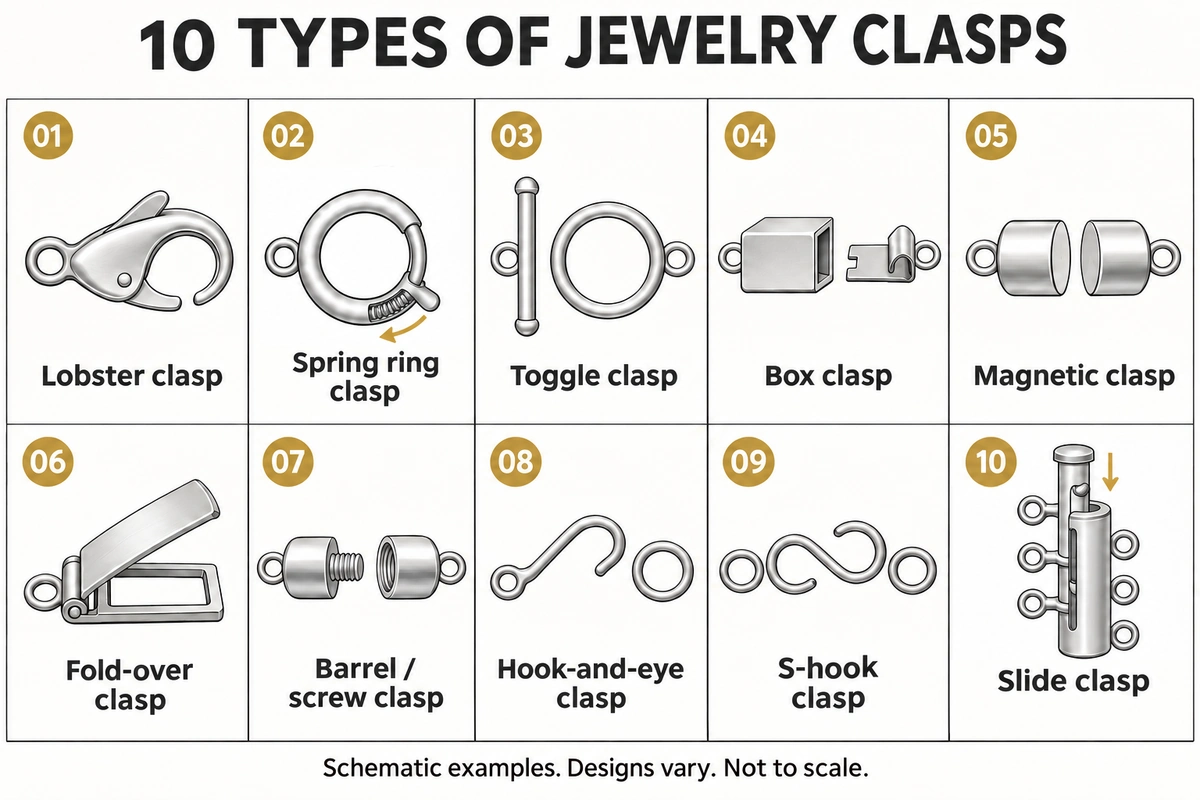
A multi-strand clasp connects several chains or strands of beads; the term does not identify a separate closing mechanism. Slide, box and toggle clasps can all have multi-strand versions. When sourcing or customizing one, check the actual closure structure as well.
Choosing a Clasp for Your Design
Fine Chains Need Proportion and Usability
For a small pendant on a fine chain, start by comparing smaller lobster clasps and spring rings. A large clasp can make the chain end look bulky, while a very small tab can be hard to grip. Attach the clasp, end ring and extender chain to the necklace and try it on. That gives you a better basis for choosing than a photo of the clasp alone.
Make the Closure Part of a Decorative Bracelet
If the clasp will sit at the front of a bracelet, compare a toggle with a box clasp that has a decorative face. A toggle bar and ring can contribute to the design, but the bar still needs room to move. A large bead placed directly beside it, for example, may block it from passing through the ring. Plan this connection while developing the strand, and try fastening the bracelet with one hand.
Check the Connections on Multi-Strand Pieces
For several bead strands or layered chains, compare slide and box clasps with multiple attachment loops. Check loop spacing and the size of the strand ends as well as the number of strands. If the chains have different lengths, assemble them at the intended lengths and observe how they hang and twist. A description such as three-strand clasp is not enough to select the right model.
Check the Fit and Finish Before Approving Samples
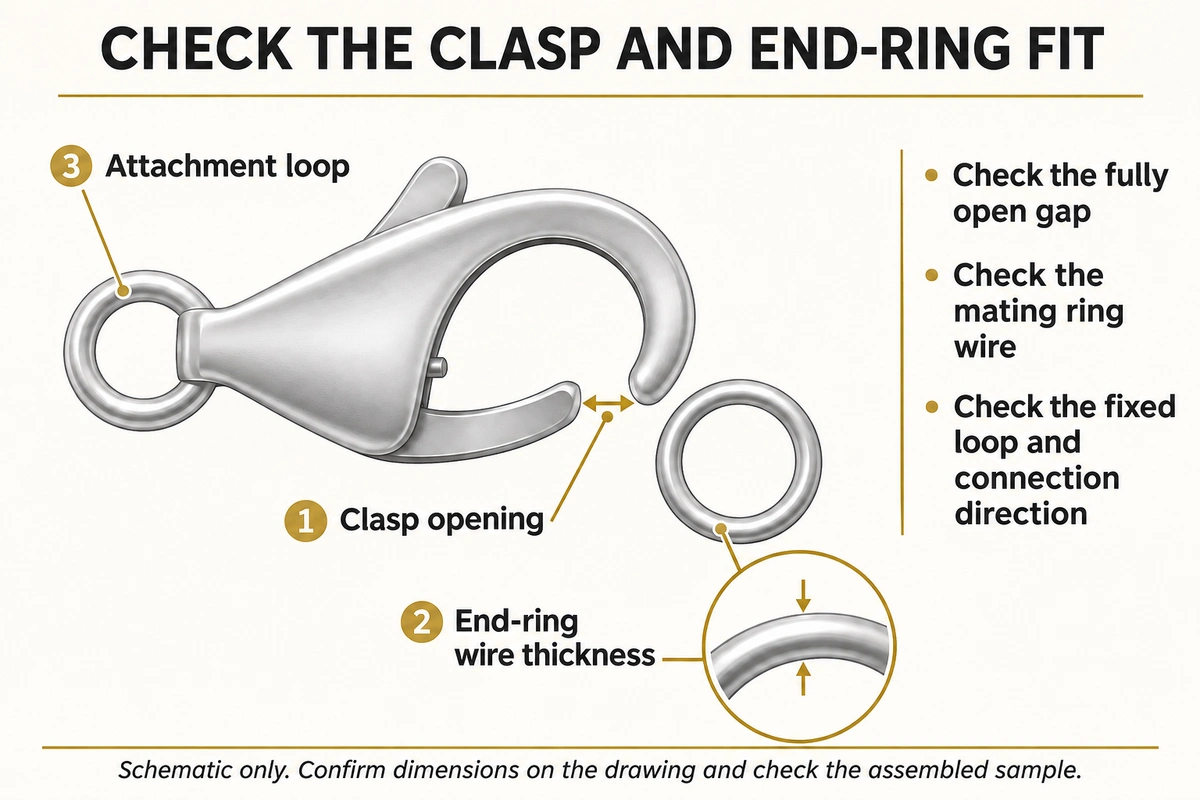
A clasp labeled 10 mm does not tell you whether the end ring will fit. Check the clear gap when the clasp is fully open, the wire thickness of the end ring, and the hole size and orientation of the fixed attachment loop. The ring should enter smoothly and move without binding once fastened. If your brand already has a chain sample, supplying it for a fit check is clearer than specifying the clasp length alone.
Review color on the complete set, too. A pendant, chain and clasp may all be described as gold-colored and still differ in tone or gloss. Compare them under the same light. For PVD color matching, see our guide to choosing PVD coatings for custom jewelry.
Before approving samples, attach the clasp to the actual jewelry and try opening, closing, wearing and turning it. Look for incomplete closure, a binding end ring or noticeable looseness at the connections. If the piece needs specific strength, durability or finish performance, agree on the checks for that product.
For custom jewelry metal components, share the design, a matching chain or bead-strand sample, and your preferred clasp and color. Tongyong can discuss the supply scope alongside your finishing and assembly requirements. You can send a drawing or reference sample so we can review which parts need to be assessed together.
Information Sources
MJSA — The Findings File / A glossary of common types of findings and chain. Copy hosted by JK Findings.
Fire Mountain Gems and Beads — All About Clasps: A Clasp Style Guide and Easy Reference Chart. Descriptions of common clasp structures and styles.