PVD Coating Jewelry: What Should Brands Specify Before Ordering?
Developing gold-colored pendants, rings or chains? Learn what to specify for PVD coatings, how to approve matching samples and how to compare custom jewelry quotes.
Developing gold-colored pendants, rings or chains? Learn what to specify for PVD coatings, how to approve matching samples and how to compare custom jewelry quotes.
You have a design for a gold-colored pendant and a finish reference, but still need to choose between PVD and electroplating. Suppliers can offer similar-looking samples at different prices. Can the pendant and chain match? What should you approve before production? These decisions depend on the jewelry material and manufacturing process as well as the color.
For jewelry brands and sourcing teams, choosing a PVD coating for jewelry means selecting a coating system for a particular product. This guide explains what to specify, how to review samples and how to compare quotations for custom jewelry.
Physical vapor deposition, or PVD, deposits a thin film in a vacuum. Decorative coatings can produce gold, rose-gold or black appearances. PVD describes a process rather than a fixed composition, gold content or service-life rating.
PVD is worth evaluating for stainless steel pendants, rings and other components when you want a metallic appearance and a finish that meets defined wear requirements. Mirror-polished pendants, matte rings and matching chains should be assessed through samples. If your product requires an actual gold layer, specify its composition and thickness rather than simply requesting a gold color.
Brass jewelry can also be considered, but the coating system commonly involves intermediate layers. Research on decorative PVD substrates and preparation explains the importance of leveling, corrosion protection and diffusion barriers. Changing a pendant from stainless steel to brass therefore calls for a review of the complete coating system, even if the target color stays the same.
An “18K gold color” may be a color description; an actual 18K gold surface layer is a composition requirement. Tell the supplier whether you want a particular shade or a specified gold-containing layer. For the latter, request the composition, gold fineness and thickness of that layer.
Thickness must also refer to a particular layer. Total coating thickness may include underlayers and other functional layers, so it is not necessarily the thickness of the outer gold layer. Two proposals quoting the same number of micrometers can still describe different systems. Ask each supplier to identify the substrate, intermediate layers and decorative top layer.
Keep the approved color sample together with the coating requirements. A physical reference alone does not explain what the coating must contain.
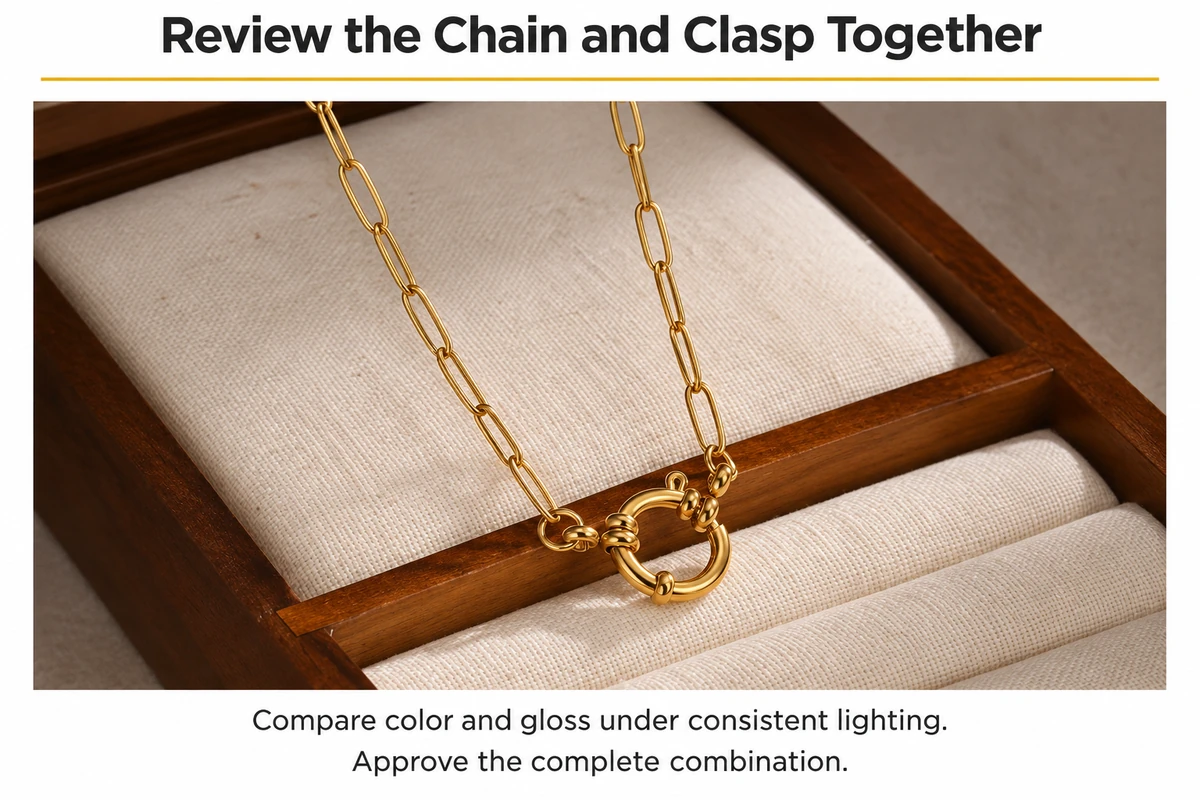
A suitable flat color sample does not settle the appearance of a complete necklace. A pendant may have a mirror polish while chain links have curved surfaces and joints. Texture and reflections affect the perceived color. Review the pendant, chain and clasp together under consistent lighting to check the intended color and gloss.
Inspect the surface before coating as well. A thin PVD film generally retains the substrate texture; visible scratches, pits and uneven polishing should be addressed beforehand. Approve the pre-coating surface for mirror finishes and the extent and uniformity of texture for matte finishes.
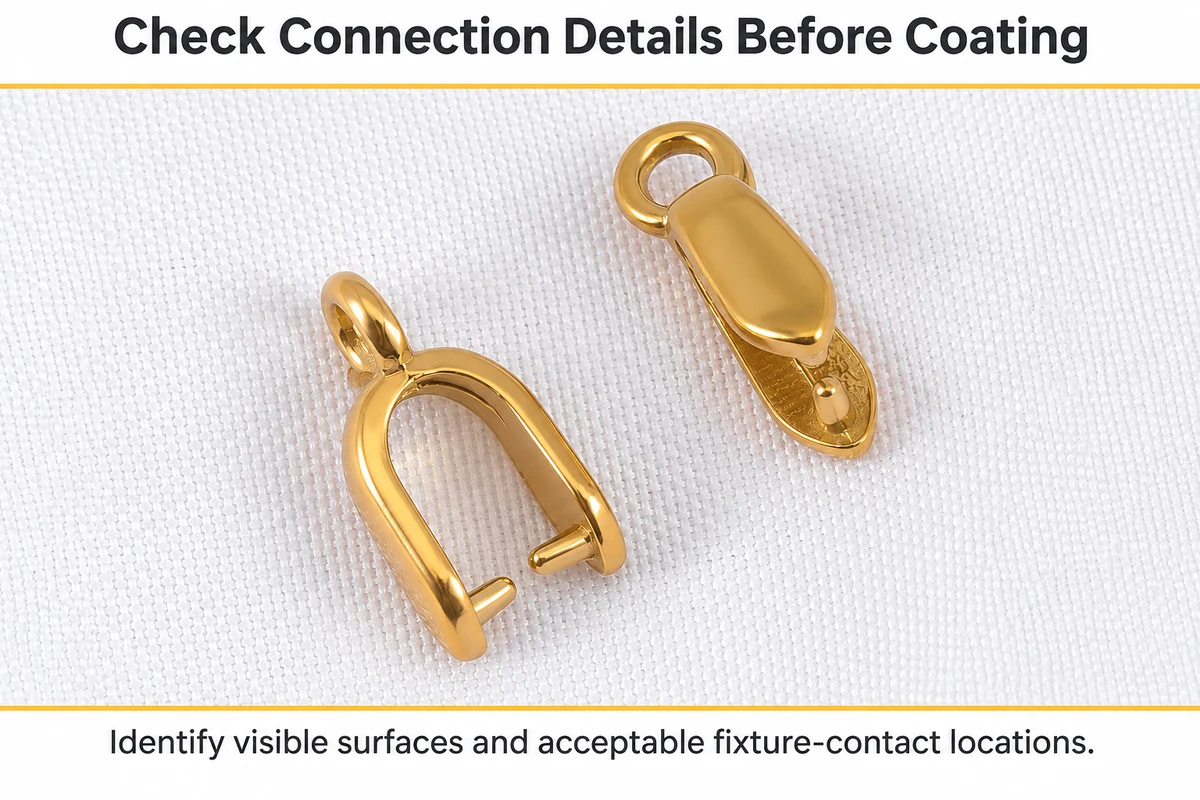
Check recessed surfaces, openwork and connection points on complex designs. PVD coverage of hidden areas depends on component geometry, and fixturing may leave marks. Identify the important visible surfaces and acceptable fixture-contact locations rather than requesting an undefined uniform finish everywhere.
Tongyong’s stainless steel pendant and chain case study includes polishing and PVD color matching. For this type of project, forming and finishing need to work together, and the assembled jewelry should be reviewed rather than approving separate color coupons alone.
Ring edges contact hard objects, chain links and clasps rub against one another, and a pendant face experiences different contact. Explain the intended use and the areas where wear matters most. Results from a pendant sample are not a service-life guarantee for a ring.
Request samples made with the planned production material, polishing method and coating system. A ring may need checks for exposed substrate and appearance changes after rubbing; a chain needs attention at its joints. Claims about resistance to perspiration or cleaning products require defined exposure conditions and verification on the finished product.
Depending on intended use, agree on relevant wear or rubbing tests, synthetic-perspiration exposure, corrosion resistance, coating adhesion and color-change checks. The test methods and acceptance criteria should reflect the product and sales-market requirements; every item does not need the same test combination.
When reviewing a report, check whether the tested item matches your product, what conditions were used and how wear or discoloration was judged. Passing a test does not translate directly into a number of years of wear. Purchasing decisions need repeatable requirements and a clear basis for comparing later batches with the approved sample.
PVD can be part of a wear-resistant decorative system, while gold electroplating also has different underlayer, gold-layer and protective-layer options. The processes can be combined, for example by electroplating an underlayer before applying PVD. Choose according to the required color, gold content and performance of the jewelry.
Ask suppliers to quote against the same drawing, material, quantity and appearance requirements, and align the following scope.
| Scope to align | Why it matters |
|---|---|
| Coating composition and thickness | A gold color does not establish gold content; gold-layer thickness differs from total film thickness. |
| Polishing and preparation | One quote may include polishing and correction, while another covers coating only. |
| Pendant chain and clasp supply | Matching and supplying a complete set differs from coating a pendant alone. |
| Samples and acceptance checks | Confirm the agreed color samples and appearance and performance checks. |
If prices differ substantially, ask whether the difference comes from the material, coating system or preparation and finishing operations. You can then decide which requirements to retain while comparing the jewelry you actually intend to purchase.
For a custom jewelry project, share a drawing or existing sample, the substrate, target color, expected quantity and whether you need a pendant, chain or complete set. Include any specified gold layer, wear requirements or skin-contact requirements. If you do not yet have a complete process specification, ask the supplier to propose a sampling approach based on the intended use.
Tongyong can discuss the supply scope for jewelry metal components together with finishing and assembly requirements. Send your design and color reference through our contact page to discuss which requirements need confirmation on samples.
Santa Fe Symposium — Physical Vapor Deposition of Decorative Coatings for Jewelry, David A. Goodrich, 1996, public abstract.
Vorobyova et al. — PVD for Decorative Applications: A Review, Materials, 2023, 16(14), 4919.
Ionbond — Decobond Gold 18K, decorative coating surface and coverage information.
ECHA — REACH Annex XVII Entry 27 on Nickel, a reference for nickel-release requirements for relevant skin-contact articles.
Base the claim on the intended finished product and verified exposure conditions. Fresh water, shampoo, pool water and seawater are different exposures. PVD alone is not a basis for a universal promise. Ask the supplier to confirm the substrate, complete coating system and relevant checks before deciding what the product description can say.
The terms PVD and stainless steel are not sufficient evidence. Consider the substrate, intermediate layers and parts that contact skin, and check the applicable substance and nickel-release requirements for the sales market. Relevant skin-contact articles are subject to nickel-release restrictions in the EU; adding a non-nickel coating does not automatically exempt them. Support claims with evidence for the finished product. Information about ordinary decorative jewelry does not establish suitability for piercing jewelry.

Share your drawing. Let’s discuss how to make your part.
From prototypes to production.
Get Started Today
Upload your drawings and specifications. Our engineers will review and respond with an engineering review within 24 hours. All inquiries are treated with strict confidentiality.
We use cookies to collect information about how you use this website. We use this information to optimize website functionality and improve our services. Privacy Policy