Metal surface finishing is often treated as the final production step. In practice, it should be considered before machining dimensions, forming details, assembly methods, and cosmetic requirements are finalized.
A surface finish can change much more than color. It may affect corrosion behavior, wear, electrical contact, surface texture, coating adhesion, cleaning, and final fit. Threads, bearing seats, sealing faces, connector openings, and press-fit features can all be influenced by the selected process.
The practical question is therefore not:
Which metal finish is the best?
It is:
Which finish provides the required function and appearance without creating unnecessary manufacturing or assembly risk?
This guide focuses on six metal finishing processes commonly used for machined parts, sheet metal components, enclosures, and structural parts. It is not intended to be a complete list of every available treatment.
How Metal Surface Finishing Changes a Part
A clear surface finishing specification should begin with the function of the finished surface.
One part may require protection from moisture, salt, cleaning chemicals, or frequent handling. Another may need a controlled brand color, a directional brushed texture, an electrically conductive contact area, or a surface that is easier to clean.
A requirement such as “black finish” is therefore incomplete. It describes appearance, but not what the surface must withstand, how it will be inspected, or whether particular areas must remain conductive or dimensionally unchanged.
Before comparing different types of metal finishes, define the following requirements:
| Question |
Information to define |
Why it matters |
| What is the base material? |
Alloy, temper, casting, extrusion, sheet, or machined condition |
Not every process is compatible with every material |
| Where will the part be used? |
Indoor, outdoor, humid, chemical, coastal, or high-contact environment |
The environment affects coating and testing requirements |
| What must the surface do? |
Corrosion protection, wear resistance, appearance, conductivity, or cleanability |
Different functions may require different processes |
| Which dimensions are critical? |
Threads, holes, fits, sealing faces, bearing seats, and grounding pads |
Finishing can affect dimensions or electrical behavior |
| How will quality be accepted? |
Standard, thickness, color sample, roughness, inspection method, or approved sample |
A process name alone may not define an acceptable result |
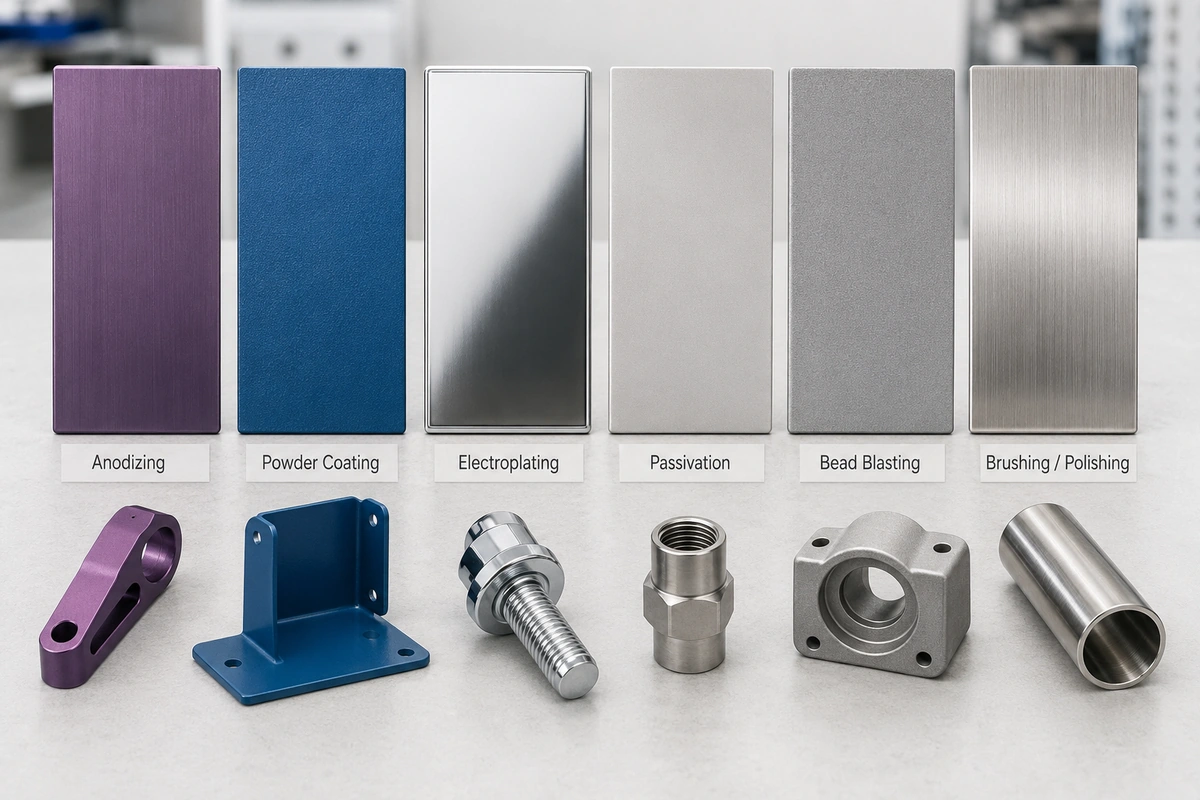
Six Common Metal Finishing Processes
The following table summarizes six processes frequently considered for custom metal parts.
| Process |
Common materials |
Main purpose |
Important design consideration |
| Anodizing |
Aluminum and aluminum alloys |
Decorative or protective oxide coating; hard anodizing for specified engineering applications |
Alloy, governing standard, coating type, color, sealing, and dimensional growth |
| Powder coating |
Aluminum, steel, and other suitable substrates |
Color, texture, and protective organic coating |
Film build, masking, deep recesses, grounding, and curing compatibility |
| Electroplating |
Steel, copper alloys, and other compatible metals |
Metallic deposit for corrosion protection, conductivity, wear, solderability, or appearance |
Plating metal, thickness, substrate preparation, and hydrogen-embrittlement risk for susceptible high-strength steels |
| Stainless-steel passivation |
Stainless steel |
Removal of free-iron contamination and support or restoration of a passive surface condition |
Not the same as descaling or pickling, and not intended to create a thick decorative layer |
| Bead blasting or abrasive blasting |
Aluminum, stainless steel, and other metals |
Matte texture, cleaning, or preparation for a later coating |
Media, particle size, pressure, distance, angle, thin walls, edges, and contamination control |
| Brushing or polishing |
Aluminum, stainless steel, brass, and other metals |
Directional texture, gloss, smoothness, and cosmetic appearance |
Grain direction, visible surfaces, roughness, and sample approval |
Standards used for anodizing
ISO 7599:2018 applies to decorative and protective anodic oxidation coatings on aluminum and aluminum alloys. It explicitly excludes hard anodic oxidation coatings used mainly for engineering purposes and directs users to ISO 10074 for that category.
The terms Type II and Type III, which frequently appear on U.S. engineering drawings, come from the MIL-PRF-8625 classification system. Type II generally refers to sulfuric-acid anodizing, while Type III refers to hard anodic coatings. ISO standards, customer specifications, and company standards may use different terminology, so the drawing should always identify the governing standard and required coating properties.
Process details that are easy to overlook
Stainless-steel passivation should not be described as ordinary cleaning. ASTM A967/A967M covers nitric-acid, citric-acid, and electrochemical treatments and includes methods for confirming treatment effectiveness. It also addresses the removal of contaminant iron from chemically clean stainless-steel surfaces.
Bead blasting and abrasive blasting should not be treated as identical visual processes. Glass bead generally produces a softer, more uniform matte appearance, while harder or sharper abrasives may form a more pronounced surface profile. Results depend on media type, particle size, pressure, angle, distance, and exposure time.
Deep tool marks, dents, or scratches may remain visible. Thin walls, precision edges, sealing faces, and stainless-steel parts also require special attention. Media used on stainless steel should be controlled to reduce the risk of ferrous contamination.
Electroplating specifications for high-strength steel parts should account for potential hydrogen-embrittlement risk. The correct controls depend on material strength, cleaning, plating chemistry, geometry, and the governing standard. A general article should not prescribe a single baking temperature or duration for every material.
Powder coating requires more than selecting a color. The selected powder must reach its specified metal temperature for the required cure time. Inserts, adhesives, seals, heat-treated materials, and previously assembled components must therefore be checked for compatibility with the curing cycle.
How to Choose Between Different Metal Surface Finishes
The most effective selection process begins with the part requirements rather than the finish name.
Start with the material and manufacturing route
Anodizing is primarily used for aluminum. Passivation is intended for stainless steel. Powder coating can be applied to several compatible metal substrates, while electroplating options depend on both the base material and the deposited metal.
Material grade and manufacturing route can also affect appearance. Two aluminum alloys processed under similar conditions may not produce identical anodized color or texture. Weld zones, castings, extrusion surfaces, machined areas, and heat-affected regions may also respond differently.
The material, condition, and production route should therefore be confirmed before the finish is selected. See our custom metal manufacturing capabilities for the manufacturing processes that may need to be considered together with finishing.
Define the actual service environment
A finish used on an indoor control panel faces different conditions from one used on outdoor equipment, a marine component, or a frequently cleaned industrial part.
The RFQ should explain whether the part will be exposed to:
- moisture or condensation;
- salt or coastal air;
- cleaning chemicals or process fluids;
- ultraviolet light;
- regular abrasion, handling, or impact;
- elevated temperatures;
- repeated cleaning or sterilization.
The phrase “corrosion-resistant finish” is not sufficient by itself. The exposure conditions and acceptance requirements must also be defined.
Separate function from appearance
A finish can look suitable and still be technically unsuitable.
A coating may provide the requested color but cover an electrical grounding area. A highly polished finish may satisfy an appearance requirement but make handling scratches more visible. A thick coating may protect an enclosure while reducing a connector opening or interfering with an insert.
A practical decision order is:
- function and service environment;
- fit and assembly;
- material compatibility;
- appearance and color;
- cost and production requirements.
Consider the complete manufacturing process
A finish cannot always hide what happened during machining, welding, bending, grinding, or polishing.
Anodizing generally follows the existing aluminum surface instead of leveling it. Blasting may create a more uniform texture, but it will not automatically eliminate deep defects. Powder coating provides greater visual coverage, but poor cleaning, incomplete pretreatment, or badly prepared welds may still affect adhesion and appearance.
The chosen metal surface finishing technique should therefore be reviewed together with the complete production route.
For sheet-metal housings and cabinets, review our sheet metal fabrication capabilities. For extruded aluminum components, see aluminum extrusion and secondary processing.
What Metal Surface Finishing Tests Can—and Cannot—Prove
Surface preparation and testing are important, but their purpose must be understood correctly.
AMPP SC 05 is a standards committee rather than one individual surface-preparation specification. It develops and maintains standards, guides, and reports covering abrasive media, cleanliness, surface profile, soluble contaminants, and related preparation methods.
Depending on the finish, a project may use:
- coating-thickness measurement;
- surface-roughness measurement;
- adhesion testing;
- color or gloss measurement;
- corrosion testing;
- an approved visual sample;
- first-article inspection.
The correct method depends on the process, application, and product specification.
Salt-spray testing is often overinterpreted. ASTM B117-26 defines the apparatus, procedure, and conditions for maintaining a salt-fog environment. It does not establish one universal exposure time for all products or convert test hours into actual outdoor life.
Therefore:
A statement such as “500 hours of salt spray equals five years outdoors” should not be made without product-specific correlation and reliable exposure data.
The required test duration, scribe method, evaluation area, permitted defects, and pass/fail criteria should be defined by the product specification or an agreed inspection plan.
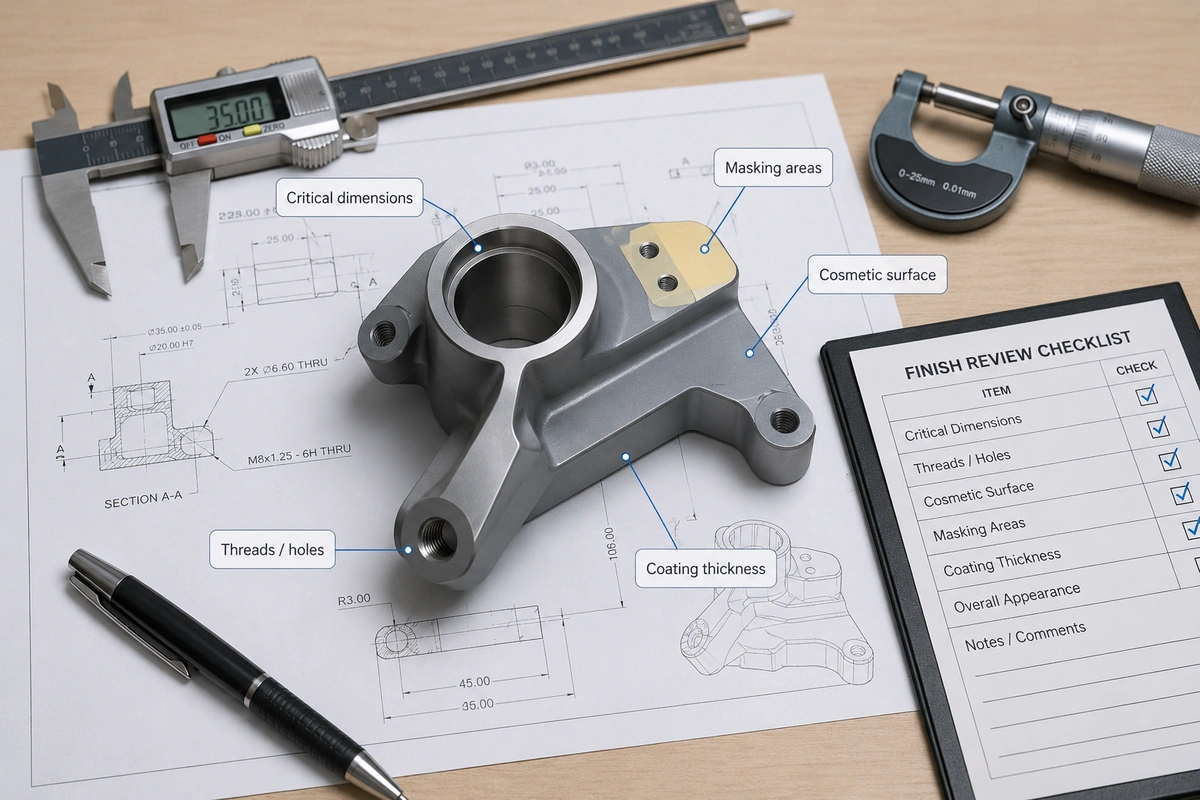
Metal Surface Finishing RFQ Checklist
A clear RFQ does not need to be complicated, but it should remove uncertainty.
| RFQ item |
Information to provide |
| Base material |
Material grade, alloy, temper, and manufacturing condition |
| Finish |
Process name and applicable standard, where known |
| Appearance |
Color system, gloss, texture, grain direction, and cosmetic surfaces |
| Functional areas |
Grounding pads, sealing faces, bearing locations, threads, and mating surfaces |
| Masking |
Areas that must remain untreated or uncoated |
| Dimensions |
Critical post-finish dimensions and tolerances |
| Environment |
Indoor, outdoor, humid, chemical, coastal, or high-contact use |
| Inspection |
Thickness, roughness, adhesion, color, corrosion test, or approved sample |
| Production |
Quantity, sample approval, first article, and packaging requirements |
When the exact process has not yet been selected, describe the required result rather than guessing a finish name.
For example:
Outdoor aluminum enclosure with a matte dark-gray appearance, two uncoated grounding areas, threaded inserts, and connector openings that must meet final dimensions after finishing.
That information gives the engineering team enough context to review the material, masking, tolerances, and suitable finish.
For a closer comparison of aluminum finishes, read our powder coating vs anodizing guide. You can also review our surface finishing capabilities.
To begin a project review, send your drawings and finishing requirements.
 Have a Custom Manufacturing Project?