A common requirement in custom screw projects sounds contradictory at first: the screw must resist loosening in vibration, but it still needs to come apart when the product is adjusted, opened, serviced, or operated by the end user.
The engineering question is not whether both goals can coexist. It is how much locking is required and what “removable” means for the product. A screw that a consumer should remove with a screwdriver is a different design problem from a fastener that a technician can remove with a torque tool. The expected number of removal cycles also matters.
For that reason, “vibration resistant” alone is rarely enough information to select a locking method. It is more useful to start with the application: where the screw is used, what the joint does, what vibration or shock it sees, and why it must later be removed. Those conditions define the practical balance between locking performance and removability.
Why Can a Tightened Screw Still Loosen Under Vibration?
A threaded joint relies on preload to maintain clamp force. Vibration by itself does not mean that a screw will automatically rotate loose. The more important question is whether relative movement develops between the clamped parts and becomes large enough to overcome the frictional constraints in the joint.
Gerhard Junker’s classic work on self-loosening examined this behavior under transverse loading. When relative motion occurs perpendicular to the bolt axis, the threads and bearing surfaces can repeatedly slip. Preload can then fall, and continued movement may eventually lead to visible rotational loosening.
ISO 16130:2015 uses transverse loading to evaluate the locking behavior of bolted connections. The standard also limits how the result should be interpreted: it is intended for comparative evaluation of locking elements under specified test conditions, and the stiffness distribution of the test equipment can influence the result. A test result therefore should not be treated as proof that a locking method will not loosen under every service condition.
The failure condition also needs to be defined. Some products are sensitive to loss of clamp load, some to visible fastener rotation, and others primarily need to prevent complete fastener disengagement. NASA-STD-5020B makes a similar distinction when discussing prevailing-torque locking devices: under severe vibration and shock, one important function is to help prevent complete separation, but that does not mean the original preload will necessarily be maintained. NASA’s standards record shows NASA-STD-5020B was revalidated on January 5, 2026.
Before selecting a locking method, it is therefore more useful to identify the failure mode the product cannot tolerate than simply to ask for the strongest possible lock.
“Removable” and “Easy to Remove” Are Not the Same Requirement
Removability is often written as a yes-or-no requirement, but it is not that simple in an actual assembly.
A screw intended for removal by a consumer with a hand screwdriver has a different acceptable removal torque from one handled by a trained installer. A joint opened once during the product life is also different from one opened repeatedly. Two locking products can both be classified as removable while requiring very different effort to break loose.
Henkel’s current published data illustrates the point. Under its M10 steel nut-and-bolt test conditions, low-strength LOCTITE 222 lists a breakaway torque of 6 N·m, while medium-strength LOCTITE 243 is approximately 26 N·m. Both are described as removable with normal hand tools.
Those figures should not be transferred directly to other thread sizes, materials, finishes, or assemblies. They simply show why removable is not a single performance level.
If a screw is expected to be removed only once, cleaning and reapplying a liquid threadlocker may be acceptable. If the product is designed for repeated opening, however, repeated thread preparation and adhesive application can affect assembly efficiency and user experience. The locking method has to fit the way the product will actually be used.
Common Locking Methods Differ Most in How the Assembly Is Used Later
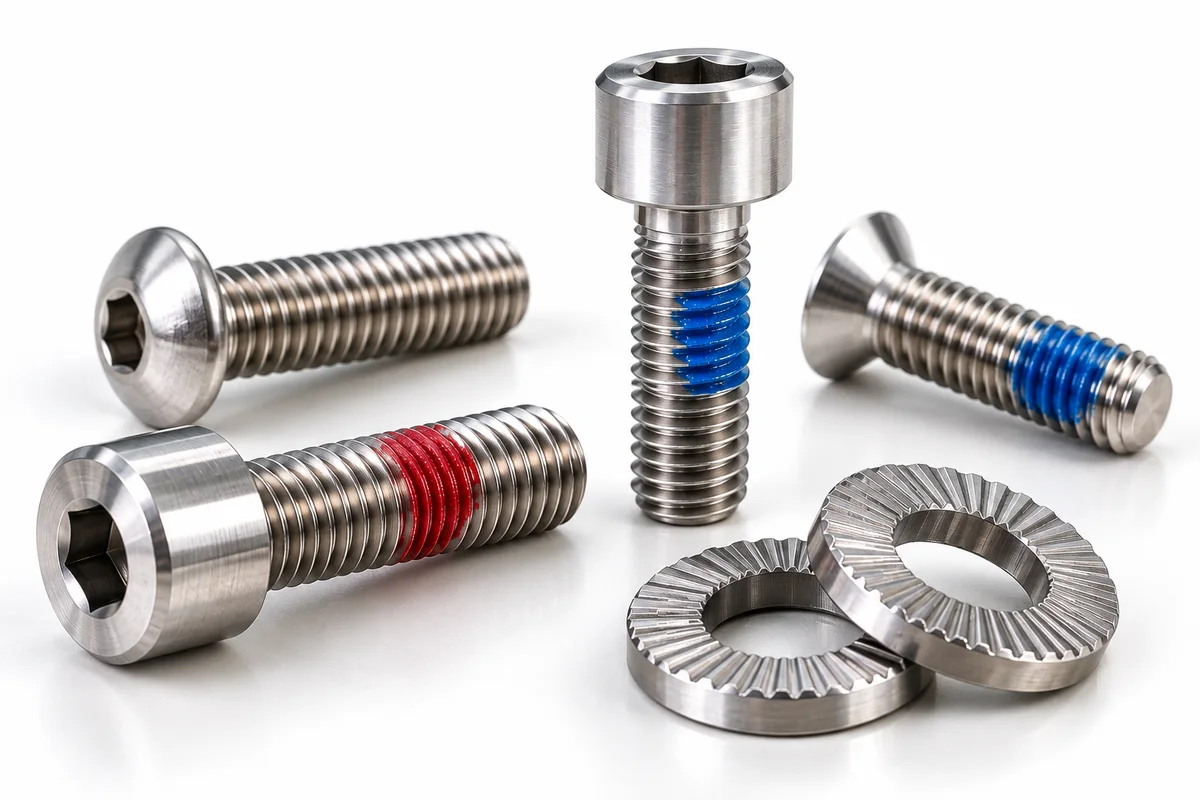
The main locking options used in custom fasteners are not just stronger or weaker versions of the same idea. They generate resistance in different ways, which changes installation, removal, and reuse behavior.
Liquid threadlocker cures between mating metal threads. Low-, medium-, and high-strength grades can be selected for different locking and removal requirements. For joints that are rarely opened, this can be a straightforward solution. If the assembly must be opened frequently, cleaning, reapplication, cure behavior, and the final assembly process also need to be considered.
Another route is a pre-applied mechanical locking feature. For custom vibration resistant screws that still need normal disassembly, Tongyong may evaluate a nylon patch or another prevailing-torque locking element. The locking feature is applied directly to the fastener, so the final assembly does not require liquid adhesive to be dispensed on site.
Nylok describes its Nylon Torq-Patch as a prevailing-torque locking element. As the fastener is engaged, the nylon patch is compressed and creates continuing rotational resistance. Its published information also emphasizes reusable and adjustable characteristics.
For a custom part, the value is not simply adding a locking treatment. Screw geometry, material, surface finish, and locking requirements can be reviewed as one component specification, with the locking feature delivered as part of the fastener.
Prevailing torque should not simply be maximized. Additional rotational resistance affects installation torque, and locking torque can change after repeated installation and removal. When reuse is a defined requirement, it is more meaningful to specify the locking performance required after a stated number of cycles than to ask only how many times the screw can be reused.
Where the product can accommodate an additional component, a separate mechanical locking device is another option. Wedge-locking washers use paired washers with cams and serrations rather than relying on added thread friction alone. Nord-Lock explains that when the cam angle is greater than the thread pitch angle, attempted reverse rotation creates a wedge effect between the cam faces that restricts further loosening.
This approach remains mechanically removable, but it adds components and axial stack height, which may make it less suitable for compact products.
Side-by-Side Comparison
| Method |
Locking mechanism |
Removal behavior |
Key custom-design considerations |
| Low/medium-strength threadlocker |
Cures between mating threads |
Removable; breakaway torque varies by grade |
Grade, thread size, material, reassembly process |
| High-strength threadlocker |
Higher-strength cured bond |
Some grades are difficult to remove and may require special methods |
Whether infrequent removal is acceptable; possible heat-assisted removal |
| Nylon patch |
Prevailing torque |
Adds resistance during installation and removal; suitable for removable joints |
Patch location/coverage, target torque, installation-removal cycles |
| Localized thread interference |
Thread interference creates prevailing torque |
No liquid adhesive required during final assembly |
Torque retention after repeated cycles; thread wear |
| Wedge-locking washer |
Mechanical wedge action restricts reverse rotation |
Mechanically removable |
Available stack height, mating surfaces, additional components |
This comparison is intended to narrow the engineering options, not to identify a single “best” locking method for every application.
For Custom Screws, Start With the Product Use Case
During early product development, the customer does not need to decide at the first RFQ whether the screw must use a nylon patch, liquid threadlocker, or another mechanical locking method. Describing the product and the required outcome is usually more useful.
Key information includes where the screw is installed, whether it primarily clamps, locates, or retains a component, what vibration, shock, or motion the product experiences, why the joint must be opened, and who will open it. If the same fastener must be reused, locking performance after repeated cycles should be considered from the beginning.
Once those basics are clear, material, surface finish, operating temperature, mating-part condition, and installation tools can be reviewed. For a product intended to be opened by the end user, removal effort and ease of operation may matter more; in industrial assembly, locking stability, installation torque, and batch consistency may carry more weight.
Customers do not need every process parameter finalized before requesting a quote. Product use, an existing drawing or sample, and the problem to be solved are enough to start an engineering discussion. Screw geometry, material, finish, and the locking requirement can then be refined together.
That is one of the practical differences between custom manufacturing and buying a standard catalog fastener: the required product outcome comes first, and the locking method can be narrowed down through engineering communication.
Conclusion
A screw that resists self-loosening in service but can still be removed when required is not an inherently conflicting specification.
The design has to balance locking mechanism, removal torque, reuse, assembly process, and the actual dynamic loads seen by the product. Some applications are better suited to liquid threadlocker, others to a pre-applied prevailing-torque feature, and some to a separate mechanical locking device.
For custom screws, there is little value in selecting a locking method before the application is understood. Define the use case and removal requirement first, then select and validate the locking approach around the real assembly.
Need a Custom Screw That Resists Loosening but Remains Removable?
If your product has specific requirements for thread size, material, surface finish, locking method, installation torque, removal torque, or reuse, you can provide a drawing, sample, or application details to Tongyong.
We can review the role of the fastener, assembly method, and service environment together and evaluate whether a pre-applied locking feature, threadlocker, prevailing-torque design, or another locking approach is appropriate. The locking requirement can be considered together with the screw dimensions, material, and surface finish rather than as an afterthought.
Discuss Your Custom Screw Project
References
 Have a Custom Manufacturing Project?