Whether you’re selecting a material for a new MIM (metal injection molding) part or converting an existing machined part to MIM, the starting point is how the part will be used. For engineers and buyers sourcing custom parts, risks such as deformation, wear, and corrosion help narrow the material options. The required material condition, post-processing, and inspection also affect manufacturing cost.
Start with the Part’s Service Requirements
Material selection starts with how the part works. Its environment, loading, friction, and appearance requirements help determine which grades and post-processing options are suitable. The following questions can help clarify those requirements.
- What will the part be exposed to? Consider indoor moisture, perspiration, cleaning agents, or chloride-containing environments, along with exposure time and operating temperature.
- How will the part be loaded? Consider a one-time load, repeated latching, impact, or long-term cyclic loading. Is preventing permanent deformation enough, or does fatigue life also need to be verified?
- Where does friction occur? Consider the mating material, lubrication, and allowable wear or changes in clearance.
- Are there additional functional requirements? These may include weight, magnetic properties, electrical or thermal conductivity, and appearance after polishing or plating.
- How will the finished part be accepted? Material properties, functional tests, and surface requirements need clearly defined inspection methods and acceptance criteria.
For a latch, for example, the first step is to distinguish between permanent deformation, wear, and fracture after repeated operation. Each failure mode points to different material properties, so hardness alone is not enough to select a material.
Stainless steels are a common MIM material family, and 316L and 17-4PH are two widely used grades. Both can be used for small, complex parts, but they involve different tradeoffs in corrosion resistance, load-bearing performance, and post-processing. Once the service requirements are clear, comparing these two grades is a useful starting point.
Choosing Between 316L and 17-4PH
316L is an austenitic stainless steel; 17-4PH is a precipitation-hardening stainless steel. Corrosion resistance and ductility often drive the choice of 316L, while load-bearing strength and hardness often drive the choice of 17-4PH. The table below pairs these material characteristics with published MIM applications to show how the differences relate to actual parts.
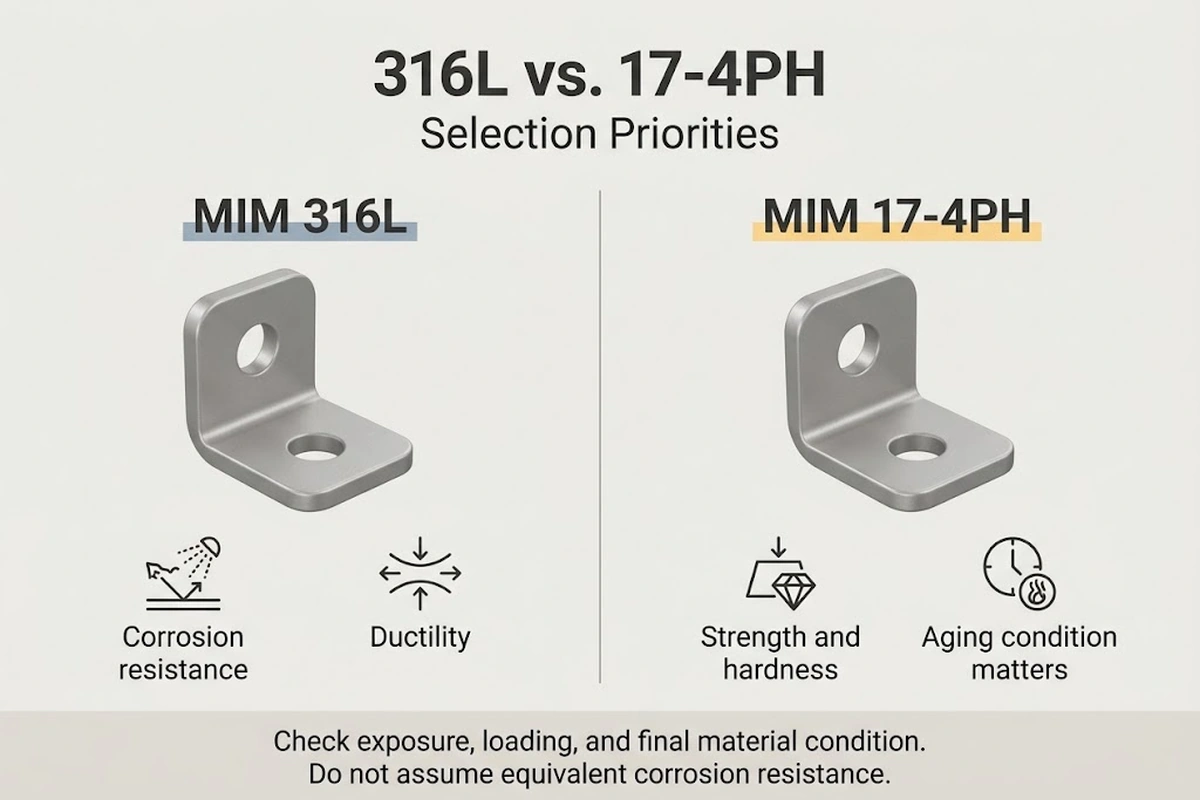
| Comparison |
MIM 316L |
MIM 17-4PH |
| Main selection priorities |
Corrosion resistance and ductility |
Load-bearing strength and hardness |
| Published MIM application examples |
Earphone nozzles and collars; complex, thin-walled bathroom hardware components |
Front and rear keeper components for industrial electric locks; door hinge components; small surgical stapler components |
| Industries represented by the examples |
Consumer electronics and professional audio; bathroom hardware |
Industrial locks; door hardware; medical devices |
| Corrosive environments |
Often a candidate when corrosion resistance is a priority; the exposure medium and surface condition still matter |
Evaluate against the actual exposure medium, surface condition, and heat-treatment condition; do not assume corrosion resistance equivalent to 316L |
| Strength and ductility |
Check whether the material properties meet the loading and deformation requirements |
Compare strength, ductility, and toughness for the specific condition |
| Material condition in the data sheet |
Check the actual manufacturing and post-processing conditions |
Evaluate the as-sintered, H900, H1100, and other conditions separately |
| Magnetic properties |
Where low magnetic response is required, test the finished part to confirm it meets the requirement. |
Magnetic; consider any effect on product function |
These application examples come from publicly available MIMA and INDO-MIM case studies and illustrate established uses of the materials. Parts in the same industry may still use different grades. Selection depends on each part’s loads, exposure medium, and final material condition.
High strength in a particular 17-4PH condition does not mean it is as corrosion-resistant as 316L. When both options meet the load-bearing and corrosion requirements, compare the total cost of heat treatment, secondary operations, and inspection.
Balancing Corrosion Resistance and Load-Bearing Requirements
Some parts face several requirements at once. Consider a hypothetical latch in a handheld device: it needs to withstand repeated opening and closing loads while also resisting corrosion from exposure to perspiration and cleaning agents.
When Corrosion Resistance Is the Priority
If 316L meets the load-bearing requirements, it can be evaluated as the corrosion-resistant option. The actual exposure medium, operating temperature, and final surface condition affect the outcome, so corrosion testing should reflect those conditions.
When Permanent Deformation Is the Main Risk
An appropriate aging condition for 17-4PH may be worth evaluating. Consider the yield strength, ductility, and toughness in that condition alongside the loading and critical cross sections. Higher strength does not remove the need to check corrosion requirements.
If contact-surface wear appears first, the mating material, lubrication, and allowable changes in clearance deserve closer attention. If fracture occurs after repeated operation, cyclic loading and fatigue testing also matter. Higher tensile strength alone does not mean better wear resistance or longer service life.
Material selection and part design can proceed together. Contact features, cross sections, and planned secondary operations affect final performance. For related geometry checks, see the MIM Part Design Guide.
When to Consider Other MIM Materials
420 and 440C for Wear Resistance and Hardness
If wear resistance and hardness are priorities, 420 or 440C may also be candidates. They are different grades, so their heat treatments and finished-part requirements need to be evaluated separately.
The processing conditions stated in published material data sheets are especially important. For example, OptiMIM’s MIM-420 data specify HIP (hot isostatic pressing) and vacuum heat treatment; its MIM-440C data specify HIP and heat treatment. Those property values apply to the HIP and heat-treatment conditions identified in the data sheets. They should not be assumed to apply to sintered parts that have not undergone the specified HIP and heat treatment.
Include Corrosion Protection and Post-Processing for Low-Alloy Steels
Low-alloy steels such as MIM-4605 can be used for load-bearing structural parts. If the service environment calls for corrosion protection, plating or another protective treatment becomes part of the plan. Heat treatment, protection, secondary operations, and inspection all affect total cost. Compare the options with the same manufacturing steps included.
Titanium for Weight Limits and Copper for Conductivity
When weight is a constraint, titanium or titanium alloys may be worth evaluating. When electrical or thermal conductivity is the main objective, copper or copper alloys may be candidates. Compare these materials against the functional requirements; the specific grade and MIM process route also affect the finished part’s properties.
MIM Material Selection Summary
The table below summarizes the materials covered in this guide and can help build a shortlist based on the part’s main requirements. Material properties depend on the specific grade, manufacturing route, and final processing condition.
| Material |
Main priorities |
Other selection considerations |
| MIM 316L |
Corrosion resistance and ductility |
Actual exposure medium, final surface condition, and whether load-bearing requirements are met |
| MIM 17-4PH |
Load-bearing strength and hardness |
Specified delivery condition: as-sintered or a particular aging condition; also check ductility, toughness, and corrosion requirements |
| MIM 420 |
Hardness and wear resistance |
Exact grade, heat treatment, corrosion resistance, and final dimensions; retain any HIP or other processing conditions associated with the data |
| MIM 440C |
High hardness and wear resistance |
Exact grade and final condition; retain the corresponding processing conditions when using data that include HIP and heat treatment |
Low-alloy steel
such as MIM-4605 |
Load-bearing structures and total cost |
Total cost of heat treatment, corrosion protection, secondary operations, and inspection |
| Titanium or titanium alloys |
Weight constraints |
Specific grade, available MIM process route, and verification of final properties |
| Copper or copper alloys |
Electrical or thermal conductivity |
Exact composition, finished-part properties, surface treatment, and project-specific supply capability |
Once you have a material shortlist, the next review can draw on the part drawings, service requirements, and post-processing plan. Through its MIM manufacturing services, Tongyong can provide manufacturability reviews of part drawings, project quotes, and sample support. The specific arrangements depend on the part’s requirements.
References
Materials: MIMA MIM Materials Range; OptiMIM Stainless Steel Materials; OptiMIM Metal Selector Tool
Application case studies: MIMA 316L Earphone Nozzle Assembly Case Study; MIMA 17-4PH Front and Rear Keepers Case Study; INDO-MIM MIM Case Studies
Material specifications: ASTM B883-24 MIM Materials Specification; MPIF Materials Standards
 Have a Custom Manufacturing Project?